Osama al-Juwaili, commander of Libya’s Western Mountain Military Region, says industrial-scale fuel smuggling by tanker has been eradicated in his area, though smaller-scale diesel smuggling persists. He says the remaining activity highlights regulatory and enforcement challenges.
Osama al-Juwaili, commander of Libya’s Western Mountain Military Region, says large-scale fuel smuggling by tanker has been eliminated within his area of command. In a video widely circulated by Libyan Arabic-language media, Juwaili said the region’s borders are now secure from such operations.
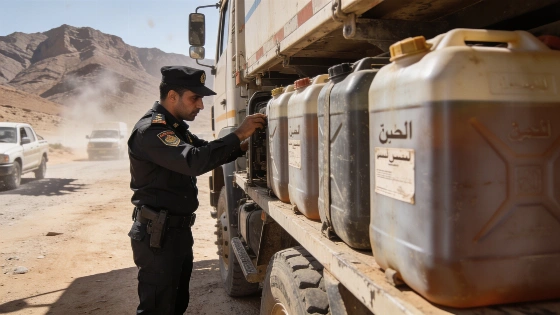
Juwaili said the remaining smuggling is limited to trucks fitted with additional or oversized diesel tanks. He said the activity is difficult to control without legislation regulating how much diesel each truck may legally transport, and called for new laws to close the loophole, arguing that enforcement alone is insufficient. The proposed legislative change is a policy demand, distinct from the security measures already being carried out against smuggling elsewhere in western Libya.
Shift in Smuggling Tactics and Enforcement Limits
Juwaili also reported that fuel sales at roadside or unofficial outlets outside the legal petrol station network have stopped in the Western Mountain Military Region. Trucks with extra diesel tanks remain a challenge because current regulations do not clearly define permissible transport quantities, information from his account.
The issue sits within a heavily subsidised national fuel market. UN reporting presented in October 2026 put the share of imported fuel diverted through smuggling at between 30% and 50%, with routes involving pipelines, ships and tanker trucks. Libya’s pump price has been reported at roughly €0.20 per litre, creating a large price difference that can make diversion highly profitable. Hanna Tetteh, the UN Secretary-General’s Special Representative for Libya, warned that “the State bears an increasing budgetary burden for subsidised fuels from which the population does not benefit once they are diverted”.
Libya imported about 8.15 million metric tonnes of fuel during the first nine months of 2026, at a reported cost of $8.9 billion. Applying the estimated 30% to 50% diversion rate to those imports points to potential losses of up to $4.4 billion over that period. The estimate concerns the national market, not the volume moving through Juwaili’s command area. A reduction on one road corridor would so represent a local enforcement result, not evidence that the wider smuggling trade has ended.
The Western Mountains form part of a broader network of routes linking the coast to southern Libya and neighbouring countries. The Zawiya refinery, described in a regional fuel-trade analysis as Libya’s largest operational refining facility, has a reported capacity of 120,000 barrels per day. The analysis describes fuel moving from north-western cities including Zawiya and Misrata towards areas controlled by rival authorities, then onwards towards Chad, Niger and Sudan. This wider geography shows why tanker enforcement in the mountains addresses one part of a system spanning multiple routes and jurisdictions.
Security pressures around Zawiya also affect the fuel system independently of roadside checks. In August 2026, drone strikes hit a naphtha reservoir and a water-desalination plant at the refinery. The National Oil Corporation later said unauthorised individuals had shut an isolation valve on a crude pipeline linking the Hamada and Tahara fields to the Zawiya oil-reception terminal. Separately, Libya’s Attorney General’s office has used security bodies in measures against smuggling connected with the refinery, including reported prosecutorial action involving the detention of a militia commander assigned to guard it.
Regional Implications
Juwaili’s claims concern the Western Mountain Military Region, while the UN estimates describe smuggling across Libya as a whole. Fuel can also be rerouted through other corridors or move through infrastructure and jurisdictions beyond the reach of a regional command. The countrywide figures so provide context for the scale of the problem, but do not quantify the amount passing through the Western Mountains.
Further progress may depend on legislative reform and coordination across regions, alongside enforcement at transport routes and petroleum infrastructure. The commander’s account describes an asserted end to large-scale tanker smuggling in his area, while the remaining truck-based activity points to the regulatory challenge he says must be addressed.