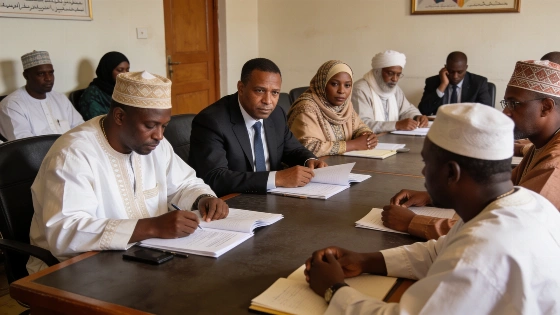
Mauritania's ruling coalition and pro-presidential parties have postponed the selection of their seven representatives to the national dialogue supervisory commission, opting for further internal consultations and expanding their alliance with new party admissions.
The Mauritanian presidential majority has hit pause on a critical step in the national dialogue process, deferring the appointment of its seven delegates to the commission tasked with overseeing the talks. Instead of finalizing names, the coalition opted to extend internal negotiations, exposing the underlying complexity and competing interests within the bloc supporting Mohamed Ould Cheikh El Ghazouani.
At the heart of the delay is a struggle to balance representation and define the bloc's unified stance on the issues up for debate. The parties have now mandated a smaller committee to draft a proposal that will clarify their positions and objectives, a move that signals both the lack of consensus and the high stakes attached to the dialogue's outcome.
Supervisory Commission Formation Stalls
The decision to postpone came after a late-night meeting, where party leaders reviewed the outcomes of earlier discussions between the head of the supervisory commission and principal dialogue actors. While the majority bloc endorsed the mechanism for selecting independent figures and civil society representatives to the commission, it stopped short of resolving its own internal nominations.
In a parallel development, the coalition agreed to admit the Parti HALEM and the Parti de la réconciliation nationale pour le développement, broadening the pro-presidential alliance at a moment when unity is under scrutiny. This expansion is designed to reinforce the bloc's negotiating weight, but it also introduces new variables into an already delicate balancing act.
Strategic Stakes and Regional Context
The composition of the supervisory commission is not a mere formality. It will shape the credibility and direction of the national dialogue, which is expected to address sensitive political and institutional questions. The delay in naming delegates underscores the challenge of forging a coherent front among parties with divergent priorities, even when united under the presidential banner.
Such internal recalibrations are not unique to Mauritania. As reported earlier in Algeria, coalition management and the timing of key decisions can have direct consequences for public trust and the effectiveness of government-led initiatives.
By choosing to postpone rather than rush appointments, the Mauritanian majority signals both caution and a recognition of the risks inherent in a fractured approach. Yet, this delay also exposes the fragility of the coalition's internal consensus and raises the stakes for the next round of talks. The real test will be whether the expanded bloc can translate its numerical strength into a unified negotiating position, or whether the search for consensus will continue to paralyze decision-making at a moment when institutional credibility is on the line.