A first-instance court imposed two-year terms and 15,000-dirham fines on four students after a Rabat protest for Sahrawi prisoners. Rights advocates are calling for greater international scrutiny of Morocco.
Fewer than 40 people had gathered outside Morocco's prison administration headquarters in Rabat when security forces surrounded the protest to prevent others from joining. Relatives of Sahrawis imprisoned after the 2010 Gdeim Izik encampment had called the demonstration.
A court sentenced four students from Zohr University in Agadir to two years in prison. Each was also fined 15,000 dirhams. The students are Brahim Babit, Salah Eddine Sbar, El Hussein Chihab, and Mohamed Lemrabet.
Fines and a delayed trial
The students travelled more than 500 kilometres to Rabat for the 12 October demonstration, which supported prisoners who had begun a hunger strike. The trial took place on 13 November after two postponements. Sahrawi human rights defenders and students were barred from attending, as were Spanish observers Ruth Sebastián García and María Dolores Travieso.
The court imposed the same prison term on all four. Babit and Sbar had previously served prison sentences. Babouzeid Labbihi, an executive member of the Collective of Sahrawi Human Rights Defenders in Western Sahara (CODESA), described each fine as a "financial catastrophe far exceeding the penalty of deprivation of liberty" for families struggling to get by.
"Its aim is economic deterrence: to starve the activist's family so that it pressures him to abandon the struggle. It is a collective punishment," Labbihi said. He added: "The Sahrawi students are not tried because they raised a flag but because their very existence as Sahrawi political beings poses a threat to Moroccan colonisation."
The legacy of Gdeim Izik
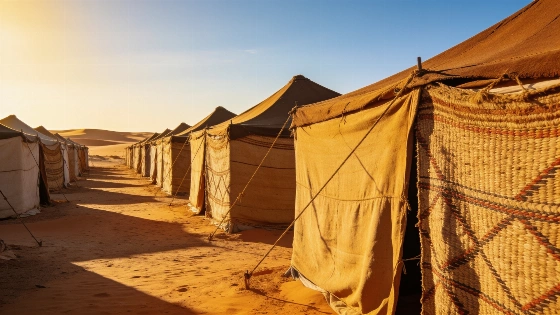
The protest camp was set up near Laayoune on 9 October 2010, amid complaints of socioeconomic marginalisation and political repression. It grew to about 20,000 protesters in 7,000 tents. The demands, which began with grievances over housing, employment and living conditions, expanded to include pro-independence slogans.
The encampment became a major flashpoint in the wider Western Sahara dispute, in which Morocco controls most of the territory and the Polisario Front claims independence. Calls for the UN mission in Western Sahara to have a broader human-rights monitoring role became part of the international debate; Morocco opposed expanding the mission's mandate.
Moroccan military and police forces dismantled the camp on 8 November. The Polisario Front said 700 Sahrawi civilians were wounded, 163 went missing, and 36 people were killed, including an eight-year-old. Morocco acknowledged two civilian deaths and said 11 of its security personnel had been killed.
A Moroccan military court later sentenced 21 Sahrawis to terms ranging from 20 years to life. Human-rights organizations alleged that confessions were obtained through torture and raised concerns about due process, including the use of military courts and the exclusion of civilian judges. Moroccan authorities have described the proceedings as addressing security threats linked to violence against security personnel and damage to public property. A civilian court retried the prisoners in 2017.
Nine of the prisoners began a hunger strike on 23 September 2026. Their relatives called for independent medical care and a transfer to a prison in Laayoune, closer to their families, with regular visits and phone calls. During the October protest, security forces detained seven people. Three Sahrawi human rights defenders, Hassan Douihi, Khalid Boufrayout, and Aziz El-Wahidi, were released without prosecution; the four students faced trial.
Labbihi said, "There are no institutions of higher education in Western Sahara," forcing students to go to Morocco to continue their studies. He described discrimination, cultural pressure, and clashes over protests against the occupation as part of the difficulties Sahrawi students face.
The Court of Justice of the European Union and the United Kingdom High Court of Justice have held that Morocco has no sovereignty over Western Sahara. The African Court on Human and Peoples' Rights has reached the same position. The African Union recognises Western Sahara as a member state under occupation, while the UN lists it among territories yet to be decolonised.
The Security Council's failure to renew MINURSO in October 2026 ended the mission's 35-year operation, as detailed in a report on the mission's closure.