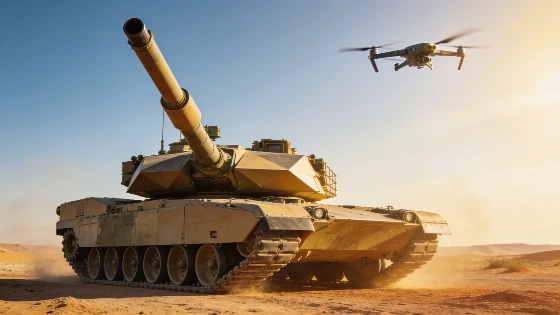
Rabat's military shift includes M1A1 Abrams tanks and armed drones. Conscription and foreign-backed production are widening the change, while rivalry with Algeria and Western Sahara shapes the capabilities Morocco has prioritised.
In little more than a decade, Morocco moved from sustaining much of its Army with second-hand equipment to fielding M1A1 Abrams tanks and armed drones. It has also acquired air-defence systems covering different ranges. The shift reaches beyond equipment: the Kingdom has restored compulsory military service and attracted foreign manufacturers to produce armoured vehicles and drones on Moroccan territory.
For Spain, the change matters because Morocco's southern flank lies across the Strait of Gibraltar. The Royal Armed Forces' transformation affects the capabilities Rabat can field. The country's ability to manufacture and maintain its own systems adds an industrial dimension to the security picture.
Strategic pressures shape the force
Rivalry with Algeria and the Western Sahara conflict help explain the capabilities Morocco has prioritised. The modernisation drive also reflects a broader national strategy to strengthen the Kingdom's regional position. Closer ties with the United States and Israel have helped Rabat acquire some equipment and capabilities. The study also points to Spain's neglect of its foreign relations as an opening Morocco has used.
A political catalyst came on 10 December 2020, when the US Administration recognised Moroccan sovereignty over Western Sahara in exchange for the normalisation of relations between Rabat and Tel Aviv. Morocco thereby entered the framework of the Abraham Accords. The recognition and normalisation are part of the context for the procurement and cooperation agreements examined in the study, rather than an explanation for every element of the military shift.
Moroccan military expenditure reached $6.3 billion in 2025, up 14.75% from the previous year and equivalent to around 3.5% of gross domestic product, according to SIPRI's Trends in World Military Expenditure 2025 report. The study's 2012-2026 timeframe begins with negotiations for a major Abrams tank contract in 2012; deliveries started in 2016.
The same state-capacity question also appears in civilian policy. A telecom coverage report described Morocco's proposal to let phones switch automatically to a rival network in areas served by only one provider.
Royal command and limited public information
The FAR are organised into the Forces Terrestres Royales (FTR), the Forces Royales Air (FRA), the Marine Royale, the Gendarmerie Royale, and auxiliary and paramilitary forces. The FTR account for around 88% of active personnel, making the Army the largest component and the main focus of the study's land-force analysis.
Estimates cited in the source put the FAR at around 200,000 active personnel, with approximately 150,000 reservists and around 50,000 paramilitary personnel. These figures are attributed to Global Firepower for 2025-2026 and described as consistent with estimates from the International Institute for Strategic Studies (IISS) and the CIA's World Factbook. The source cautions that Morocco's military opacity limits independent verification.
That opacity is rooted partly in the system of command. Mohammed V established a Ministry of Defence and General Staff after independence in 1956. Following the 1971 coup attempt and the attack on the royal aircraft in August 1972, Hassan II abolished the ministry and transferred its administrative responsibilities to a lower-ranking body reporting to the Head of Government.
The Administration de la Défense Nationale (ADN), governed by Decree 2-82-673 of 13 January 1983, handles administrative and logistical functions, including budget preparation and civilian personnel management. It has no command authority over operational forces. Effective command rests with the General Staff (État-Major Général, EMG) and ultimately with the King as Supreme Commander of the Armed Forces.
This division separates administration from operational control. The King has an effective role in appointments and promotions, as well as major strategic orientations, including policy concerning Western Sahara and military cooperation with the United States, France and Israel. The ADN, by contrast, is not a Ministry of Defence in the full sense.
Since 2010, the ADN has been headed by a Minister Delegate. Abdellatif Loudiyi held the post under the El Fassi, Benkirane, El Otmani and Akhannouch governments. Among the technical bodies linked to the ADN is the Direction Générale de la Sécurité des Systèmes d'Information (DGSSI), created by Decree 2-11-509 of 2011 and responsible for state cybersecurity.
The EMG follows a Francophone general-staff model and is divided into four bureaux covering personnel and force strength, intelligence, operations, and logistics. The Inspector General of the FAR is a senior figure below the King in the military hierarchy. Lieutenant General Mohammed Berrid took the post on 22 April 2023, combining it with command of the Southern Zone. His predecessor, Belkhir El Farouk, was replaced without an official explanation.
The creation of the Zone Est in January 2022 added an eastern command to the North and South zones amid a breakdown in diplomatic relations with Algeria. The FAR said the change would "ensure coherence in the command, control and sustainment of the land, air and maritime components of the FAR within a joint framework".
Spain's Army operates under a Ministry of Defence subject to parliamentary oversight and transparency requirements. The comparison matters for researchers: Morocco's institutional design leaves less public material on its force structure, personnel, doctrine and procurement. The study therefore draws on OSINT and IMINT reports, specialist publications and successive editions of The Military Balance, cross-checked against Josep Baqués's analysis and aggregated open sources.
Army structure and territorial posture
The FTR were established in 1956 through the integration of three contingents. Around 14,000 personnel came from the French Army and some 10,000 from the Spanish Army. Approximately 5,000 veterans of the Armée de Libération Nationale (ALN), the armed wing of the independence movement, also joined.
Moroccan officer training initially included programmes at Saint-Cyr, Toledo and Dar al-Baida in Meknes. Around 2,000 French officers and NCOs remained in the country until Moroccan commanders could replace them. The study links this history to the Army's French staff structure and Spanish influence in the armoured branch.
There is no accessible official organisational chart for the Army. Josep Baqués's work is identified as the main Spanish-language reference for reconstructing unit locations, using open-source intelligence, Moroccan institutional publications and geographic inference. The study describes a gradual change from a mechanised infantry brigade to an armoured brigade as M1A1SA tanks replaced M-60A3s, alongside changes to armoured squadrons and their support.
The article's order-of-battle table lists three independent mechanised infantry brigades, six mechanised infantry brigades, two motorised infantry brigades and three Royal armoured brigades. It also records 15 motorised infantry regiments, 13 Royal tank regiments and two Royal cavalry regiments.
The artillery organisation listed comprises 24 Royal Artillery groups: four surface-to-air groups, two rocket-artillery groups and 18 field-artillery groups. The table also includes a mountain infantry battalion, three motorised mechanised battalions, 12 border-surveillance battalions and 17 light intervention infantry battalions.
Airborne and special forces include two airborne infantry brigades and one mechanised intervention brigade, alongside four commando battalions and four parachute battalions. The Royal Guard has a light security brigade, four infantry battalions, one ski battalion and two cavalry groups. Auxiliary forces listed include 11 Makhzen Auxiliary Forces Groups, among them Makhzen Border Surveillance Units (MMS), four Green March Commandos (CMV) and Motorised Auxiliary Forces (GMM).
The study draws particular attention to northern Morocco and the proximity of land units to Melilla. It distinguishes those forces from marine infantry, which belongs to the Marine Royale. In the south, airborne infantry brigades provide expeditionary forces to the Western Sahara posture. The author interprets the north-eastern concentration of heavy forces and the southern airborne presence as evidence of a force structure oriented towards two fronts.
Conscription returns alongside domestic production
Compulsory military service first began by royal decree in June 1966. It required 18 months of service for men aged 18 to 30, until Mohammed VI abolished it in 2006. The King-led Council of Ministers approved a draft law to restore conscription on 20 August 2018; Parliament subsequently approved Law 44-18, which was formally activated on 7 February 2019.
The law set 12 months of service for Moroccan men and women aged 19 to 25. The Royal Cabinet presented the policy as a way to "promote patriotism among young people, in the context of the correlation between the rights and responsibilities of citizenship". The study also describes its military purpose: building a trained reserve and easing pressure on voluntary recruitment.
In the first call-up in 2019, 133,820 young people registered and around 15,000 were recruited, including 1,100 women. The stated aim was to expand the contingent to 50,000 soldiers by 2021. The COVID-19 pandemic halted training for much of 2020 and 2021. Registration reopened in 2022 with a target of 20,000 recruits.
Four training centres-in Benslimane, Sidi Yahia Gharb, Benguerir and Tan-Tan-were added to the seventeen existing barracks. Separately, the Kingdom has attracted foreign manufacturers to produce armoured vehicles and drones on its territory.
Morocco's 2020 Law No. 10.20 established a framework for licensed companies to manufacture and export defence and security equipment. The policy opened a path from procurement towards domestic production and maintenance, with potential exports spanning vehicles, turrets, ammunition and unmanned systems.
One major project is Tata Advanced Systems' production of WhAP 8×8 armoured vehicles in Berrechid. The factory was inaugurated in September 2025, with the locally produced component share intended to increase progressively. A related facility in the Midparc industrial zone at Nouaceur is associated with production of 30 mm gun turrets for the vehicles. Moroccan company MMI is also reported to manufacture turrets and remotely operated weapon systems.
The industrial programme extends beyond vehicles. Plans include drone manufacturing and maintenance in Benslimane, as well as medium- and large-calibre ammunition facilities in Sidi Yahya. Reported defence-industrial acceleration zones cover 75 hectares at Nouaceur and 600 hectares at Sidi Yahya, linking production and support activities across the sector.
A defence-industry roadmap reported by the Royal Cabinet sets a target of producing 40% of the new equipment required by the armed forces and security services domestically by 2035. It includes a state-owned fund of approximately 4 billion Moroccan dirhams to attract investment, alongside an export objective under which more than 65% of sector revenue would come from foreign sales. Priority areas include drones and autonomous systems, land and naval systems, defence electronics, cyber defence and artificial intelligence. The roadmap also envisages industrial zones near Marrakech and Casablanca.