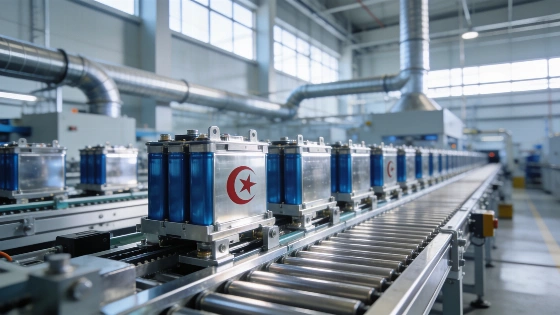
The proposed plant would give Algeria five gigawatt-hours of annual battery capacity. The government says domestic lithium technology could support energy storage and create 50,000 jobs.
On 23 November 2026, President Abdelmadjid Tebboune chaired a meeting on Algeria's planned lithium-battery factory and appointed Professor Karim Zaghib to lead its technical and technological work. The project is owned by the Ministry of Energy and Renewable Energies through Sonelgaz International. Zaghib's mandate is to study and follow the project's technical stages; the announcement marked progress on the project, not the opening of an operating factory.
Zaghib put the proposed plant's capacity at five gigawatt-hours (GWh) per year. He said the batteries would be intended for electric vehicles and stationary energy storage, serving Algeria as well as export markets. The figure describes energy capacity, not a count of cells, battery packs or vehicles. The plant's location, investment cost, construction schedule and commissioning date have not been announced.
A domestic battery industry remains in development
The appointment followed a meeting on 22 November between Zaghib and Higher Education and Scientific Research Minister Kamel Baddari. They discussed developing the battery industry, supporting a proposed electric-car project and transferring and localising technology. The meeting brought together representatives of Algeria's research and technology bodies, including the General Directorate of Scientific Research and Technological Development, the Research Center in Industrial Technologies, the Research Center for Semiconductor Technology for Energetics and the National Agency for the Valorization of Research Results and Technological Development. Radio Algérienne reported that the discussions focused on using national research and technological capabilities.
Zaghib, an Algerian-born battery scientist specialising in lithium-ion technology, returned after a career abroad. He received Canada's Lionel-Boulet Award in 2019. Speaking after his meeting with Tebboune, he said Algeria had resources and capabilities relevant to battery production, including minerals, iron and chemicals.
He described the technical objective as accelerating production of an iron- and phosphate-based industrial compound for conversion into lithium-ion battery cathode material. That concept is associated with lithium iron phosphate (LFP) batteries, although the project's final chemistry and industrial process have not been set out. Zaghib said batteries could serve electric vehicles and energy storage, with production aimed at Algerian demand and markets in Africa, Europe, North America and Asia, particularly China. He also said development of the technology could create 50,000 jobs.
Exploration and industrial policy
The government began shaping a lithium-sector strategy in November 2025, establishing an inter-ministerial committee with representatives from hydrocarbons, renewable energy, industry and higher education. Its remit was to develop a vision for the sector, which the government links to the energy transition, industrial and technological sovereignty, and higher-value manufacturing.
Algeria has conducted field studies in the southern provinces of Tamanrasset and In Guezzam with Chinese company Ganfeng Lithium. The studies reported promising indications of lithium deposits alongside other rare minerals. The government has also begun preparing a national roadmap covering exploration and extraction, with chemical processing included. Pilot projects to produce active materials for LFP batteries have been established with Algerian specialists and experts based abroad.
The battery plan joins other proposed energy initiatives, including Algeria's invitation for Bosnian company Energoinvest to participate in projects at home and elsewhere in Africa, described in an earlier account.
In November 2025, the Ministry of Energy identified lithium development as a strategic priority linked to renewable energy and electric transport. The government has said the sector should help reduce the country's carbon footprint, diversify national income and build a knowledge-based economy centred on clean technology.