National Oil Corporation Chairman Masoud Suleiman met with US State Department Senior Advisor Jeremy Berndt in Tripoli to discuss appointing an international consultancy to monitor the NOC's budget, aiming to improve transparency and efficiency in Libya's oil sector.
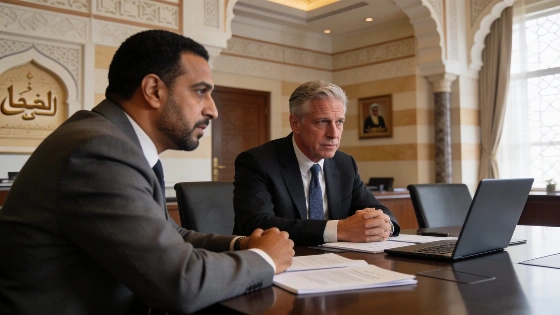
National Oil Corporation (NOC) Chairman Masoud Suleiman held talks with Jeremy Berndt, Senior Advisor for Libyan Political Affairs at the US State Department, on the possible appointment of an international consulting office to oversee implementation of the NOC's budget. The meeting took place at the NOC's headquarters in Tripoli, and Suleiman announced it on his personal social media account.
Suleiman said the discussion forms part of the NOC's ongoing efforts to strengthen cooperation with international partners and support the development of Libya's oil and gas sector. The two officials reviewed energy-sector issues, focusing on ways to improve collaboration and share expertise. The aim is to help the NOC maintain operational stability. The work also targets better performance and stronger sector capacity. The NOC remains the basic state oil institution in a sector shaped by rival political and administrative authorities.
Focus on Transparency and Resource Management
A central topic was the proposal to appoint a specialised international consultancy to monitor execution of the NOC's budget. Suleiman said the oversight is intended to ensure proper use of resources and improve spending efficiency, while strengthening transparency and governance in the delivery of projects and programmes aimed at advancing the sector.
The proposal comes amid calls for more transparent public spending. An African Union-supported joint statement on Libya urged “transparent implementation of the unified spending structure, effective oversight and progress towards a unified budget”, while stressing that the integrity and independence of the country's sovereign economic institutions should be preserved.
The scale of oil revenues makes it impressive to reconcile production and sales with state deposits. The NOC reported producing slightly more than 40.2 million barrels of crude in September 2026, or about 1.3 million barrels per day, and oil sales of approximately US$2.86 billion. In October, the Central Bank of Libya said US$361 million had been deposited during the first two weeks of the month, while the NOC said it had transferred US$1.2 billion. The apparent US$839 million difference was attributed by the NOC to an accounting mechanism that deducts fuel-import costs from crude revenues. The Central Bank said it welcomed independent audits of its records. The dispute highlights the need for transparent accounting, but does not by itself establish that funds were lost or misappropriated.
Broader Context for Libya's Oil Sector
The initiative comes as Libya continues to seek greater stability and accountability in its oil sector, which remains the backbone of the national economy. A 2026 analysis published by Taylor & Francis described how armed-group influence and leadership appointments weakened internal checks and balances within the NOC, noting that “the organisational structure was changed, and the internal checks and balances were curtailed.” It also described informal networks intersecting with formal oil institutions, alongside crude-for-fuel barter arrangements and private-sector participation in an increasingly hybrid oil economy.
Operational vulnerabilities also affect production directly. In October 2026, the NOC reported that an unauthorised group shut a valve on the Hamada-Zawiya crude pipeline “without prior coordination or approval from the relevant technical and operational authorities”. The disruption affected flows from the Hamada and Tahara fields, with potential reductions of about 50,000 barrels per day and 40,000 barrels per day respectively. The NOC has previously described Hamada's capacity under stable conditions as 50,000 barrels of oil and 10,000 barrels of condensate per day. It also reported capacity of 90 million cubic feet of natural gas per day. Tahara resumed production in 2022 at 2,500 barrels per day, with an eventual capacity of 40,000 barrels per day expected.
Budget oversight also affects project delivery and infrastructure. The Bouri Gas Utilisation Project, initiated in 2007 and suspended after 2011, was reported to have a total budget of US$1.565 billion. About US$928 million had reportedly been spent by December 2025, leaving approximately US$637 million of the stated budget unspent. Separately, an NOC technical meeting with Brega Oil Marketing Company addressed delayed projects and capacity at storage and depot facilities. It also covered loading facilities and transport bottlenecks, proposed engineering studies for pipeline routes from the Zawiya refinery, and the company's financial presentation for 2027.
Similar efforts to improve oversight and transparency have been seen in other sectors, including the recent signing of contracts for new housing units in Misrata under the Prime Minister's Housing Initiative, as reported in coverage of the National Housing and Real Estate Development Programme.
What to Watch Next
If the NOC proceeds with appointing an international consultancy, domestic and international stakeholders will closely monitor its effectiveness in improving budget implementation and sector governance. Independent review of spending could sit alongside the NOC's operational role, supporting wider efforts to strengthen oversight and work towards a unified system for public spending. The outcome may influence future approaches to transparency and efficiency across Libya's state-owned enterprises.