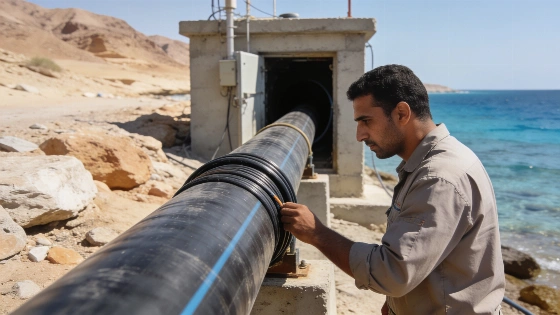
Telecom Egypt says more than 90% of Europe-Asia and Europe-Africa international traffic passes through its network. A planned cable across Sinai would add another route.
Telecom Egypt says its transit capacity has passed 330Tbps. The operator says more than 90% of international traffic between Europe and Asia, and between Europe and Africa, passes through its infrastructure.
Egypt has spent years building routes for that traffic. In July 2022, the country's communications minister said more than 90% of data exchanged between Asia and Europe passed through Egypt. Six cable landing stations had been established over the preceding two decades. Three more opened later: one at Ras Ghareb, another at Zaafarana, and the third at Sidi Kerir. Egypt then had six terrestrial routes totalling 2,700km, with five additional routes spanning 2,650km. Investment in the landing stations and new routes was put at EGP1.1bn, as Ahram Online reported.
The latest project would cut across the Sinai Peninsula. Telecom Egypt signed an agreement in early September with subsea installation company Power Sub Link to build the Sharm-Taba cable.
The planned link will run about 200km between Sharm El Sheikh and Taba. Designed without repeaters and with a high fibre count, it is specified for capacity of around 5 petabits per second. Telecom Egypt expects it to be ready for service late next year.
The cable would extend the company's Red Sea Festoon system. That route runs from Sharm El Sheikh to Ras Ghareb, then to Zafarana across the Gulf of Suez. It continues to Suez. Telecom Egypt says the wider eastern digital corridor will connect new subsea cables on the Red Sea coast with those on the Mediterranean.
Sinai is one part of a broader push to diversify Egypt's international connections. On 21 June 2022, Telecom Egypt and Greece's independent power transmission operator IPTO agreed to extend a subsea cable system between the two countries. Telecom Egypt chief executive Adel Hamed signed the agreement in Cairo. IPTO chair and chief executive Manos Manousakis also signed, as did Grid Telecom director George Psyriris.
The planned corridor combines subsea and terrestrial sections linking Africa with Asia. Its routes extend into Europe, including connections towards the Balkans. Other routes head to Genoa and Marseille. Egypt's communications ministry included the project in a programme of 18 cable systems planned for completion over the following three years, according to Ahram Online.
Telecom Egypt says its Sinai network links landing points on both coasts. It also uses the terrestrial ICE crossing, alongside other routes across the peninsula. The company's combined planned and operating network includes more than 14 terrestrial trans-Egypt routes. It counts more than 14 subsea cable landing points. Its total also includes more than 21 international subsea systems.
The operator says its geodiversified Sinai crossings use deep cable burial and concrete shielding beyond common industry practices to protect critical connections. At Sharm El Sheikh, a large marine horizontal directional drilling project is intended to limit seabed disturbance and protect coral reef ecosystems. Terrestrial routes also include solar-powered intermediate line amplifier sites.
Telecom Egypt's five-year strategy for 2026 to 2030 aims to increase the value of existing operations while creating new revenue streams. The company has established a dedicated entity for its data centre business, targeting demand from hyperscalers and global enterprises as AI and cloud services drive demand for digital infrastructure.
The data-centre strategy builds on investments announced in 2022, when Egypt presented Telecom Egypt's regional data centre and international data centre in Cairo. The facility was reported to have a capacity of 24MW and to represent an investment of EGP2.8bn. The government described data centres as part of an effort to develop the country's role in hosting and processing data. It also pointed to Egypt's role in carrying data in transit.
Telecom Egypt's consolidated revenue reached EGP58.4bn in January-September 2024, up 34% year on year, chief executive Mohamed Nasr said. The figure covers the group's overall business. The company is reorganising its commercial operations into Consumer and Enterprise segments.
It has also set up two specialised labs for the WE Innovate Star cybersecurity initiative. The labs support incubation and validation, as well as proof-of-concept development and product testing. Telecom Egypt presents the wider programme as a way to expand resilient international connectivity and develop services beyond transmission capacity.
The Sharm-Taba cable is expected to be ready for service late next year.