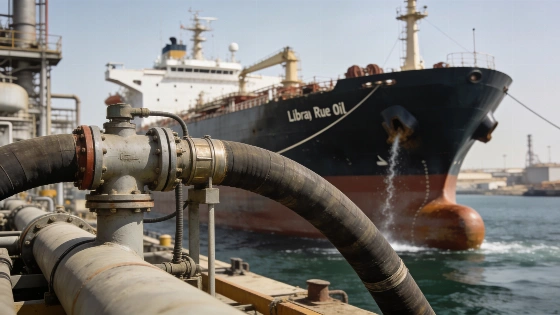
Egypt needs more gas and refinery feedstock while Libya exports far more crude than its refineries process. A gas link and pipeline remain proposals; seaborne crude under tolling is the closest option to a commercial arrangement.
Egypt consumed 5.95 billion cubic feet per day of gas in 2025 while producing 3.94 bcf/d. Libya, meanwhile, exported 335.41 million barrels of crude and sent just 47.56 million barrels to its domestic refineries. The mismatch gives Cairo and Tripoli a commercial reason to explore cooperation, though most proposals have yet to move beyond discussion or a framework.
Egyptian Foreign Minister Badr Abdelatty met Libya's Oil and Gas Minister Khalifa Abdulsadek in Tripoli, reportedly on 7 November 2026. Some reports call Abdulsadek the acting minister; neither that title nor the meeting date has been independently confirmed. Egypt's Foreign Ministry said Cairo raised a gas-network connection. It also discussed processing Libyan crude in Egypt for re-export and speeding up the rehabilitation of Libyan refineries.
Refining offers the clearest commercial route
The refining proposal has the most immediate logic. Egypt processed about 34 million tonnes in FY2024/25 against capacity of 40 Mt a year, according to Egypt Oil & Gas. Libya's crude exports were roughly seven times the volume sent to domestic refineries in 2025.
Libya's five refineries have nameplate capacity of 380,000 barrels per day. National Oil Corporation Chairman Masoud Suleiman puts actual output at no more than 180,000 b/d; the US Energy Information Administration offers a lower estimate of about 130,000 b/d, which has not been verified. Ras Lanuf, the largest facility, has nameplate capacity of 220,000 b/d and has reportedly been closed since 2013. The NOC's proposal to raise national capacity to 660,000 b/d remains a plan.
In a tolling arrangement, Libya would retain ownership of the crude and pay an Egyptian refinery a processing fee. Libya would then bear product-price risk. Other possible structures, including product swaps or revenue sharing, are illustrative options, not disclosed deal terms. No public study has been identified that sets out crude assays, expected yields or the spare capacity available for distillation and desulphurisation. On 10 November 2026, Egypt's Ministry of Petroleum and Mineral Resources listed Brent crude at $91.21 per barrel, West Texas Intermediate at $85.48 and OPEC crude at $93.21 on its market-price page.
Egypt's expensive gas imports add pressure to find lower-cost supply. Energy Institute figures show production exceeded consumption in 2021, when output was 6.56 bcf/d and demand 6.01 bcf/d. By 2025, the implied shortfall had reached about 2.01 bcf/d. S&P Global says LNG imports hit a record 9.01 million tonnes that year. Petroleum Minister Karim Badawi said in August that a typical cargo cost about $80 million, double the earlier figure of $40 million.
Frameworks and infrastructure still need terms
The gas interconnection has no disclosed route or capacity. Its tariff and timetable have also not been disclosed. A proposed Tobruk-Alexandria crude pipeline would span about 800 kilometres, with a preliminary cost above $1 billion cited by Extractives Daily and New Egypt. Its financing and capacity have not been disclosed. Seaborne crude shipments avoid the need to build that link, though they remain exposed to freight and port costs, as well as insurance and security risks.
An agreement reportedly signed by Egyptian contractor PETROJET and the NOC on 26 January 2026 covers studies on refining and exploration, with production and transport also included. It is a memorandum of understanding, not a commercial contract. Seaborne shipments under tolling are the option closest to readiness, but the terms have not been published.
The implementation hurdles are substantial. Libya's divided institutions can delay approvals, and the pipeline would require agreement from eastern and western authorities. Security risks affect infrastructure, while NOC funding is limited and Egypt faces foreign-exchange pressure. No verified balance of Egyptian arrears to Libya has been disclosed. Tripoli also has other potential buyers and partners, including Italy and Eni, as well as Turkey and international oil companies; immediate hard-currency revenue from crude sales may remain attractive.
Egypt's regional infrastructure activity has also included discussions on Djibouti port and road projects, as a previous regional report noted. That does not resolve the commercial questions in the Libya talks: investors would still need a feasibility study and transparent tolling terms. Payment support would also matter, alongside provisions for security and foreign-exchange risk.
Abdulsadek has said he plans technical talks in Cairo. Published tolling terms or a completed study would offer evidence of progress. A binding schedule for Ras Lanuf rehabilitation would also mark a step forward. Until commercial terms and financing appear in signed documents, the proposals remain at different stages of development.
This article is for informational purposes only and is not financial advice. Investors should research independently before making investment decisions and consult financial professionals. Forward-looking figures and plans are speculative and subject to change.