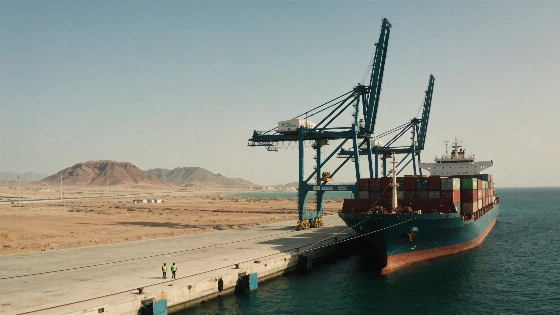
Arab Contractors has discussed a five-million-TEU terminal and a 90-kilometre road corridor with Djibouti's ports authority. Ethiopia relies heavily on Djiboutian ports for trade.
Arab Contractors chief executive Ahmed El-Assar met Djibouti's ports authority chairman Aboubaker Omar Hadi to discuss a proposed terminal and road corridor. The meeting followed earlier Egyptian-Djiboutian infrastructure talks.
The terminal is planned for a capacity of five million TEUs, with a 1,450-metre quay and a depth of 18 metres below the lowest astronomical tide. Its development follows a memorandum of understanding between Great Horn Investment Holding (GHIH) and Egypt's state-owned Holding Company for Maritime and Land Transport (HCMLT).
The road plan covers RN18 from PK13 through Holl Holl. It continues through Dasbiyo and Ali Sabieh before reaching Gualilleh, with a seven-kilometre link to Biciidley Airport. The Djibouti Ports and Free Zones Authority (DPFZA) said the meeting also explored Arab Contractors' potential role in carrying out the projects.
These remain proposals under discussion. The meeting did not establish that construction has started.
Djibouti handles roughly 95% of Ethiopia's external trade, according to Deutsche Welle. With no coastline of its own, Ethiopia depends on Djiboutian ports as its principal maritime gateway. Trade flows therefore rely heavily on the ports and the land routes connecting them to Ethiopia's interior.
The talks build on cooperation discussed during a December 2025 visit by Lieutenant General Kamel El-Wazir, Egypt's deputy prime minister for industrial development and minister of industry and transport. Egyptian and Djiboutian entities signed three agreements during the visit. They covered maritime transport and logistics. Renewable energy was another subject.
As Ahram Online reported, one agreement between Elsewedy Electric and the SGTD container terminal provided for a 23-megawatt solar power plant with battery storage. The plant is planned for a 30-hectare site in Doraleh and is intended to supply electricity exclusively to SGTD. GHIH and HCMLT signed the terminal memorandum. A separate land lease granted an initial 10-hectare plot in the Djibouti International Free Trade Zone for a logistics centre to process and export Egyptian products.
Djibouti lies near the Bab el-Mandeb strait, a key passage between the Red Sea and the Gulf of Aden. Deutsche Welle has reported that insecurity in the Red Sea has prompted shipping companies to consider longer routes, including voyages around southern Africa. The port, energy and road proposals sit within a broader expansion of Egyptian economic and transport ties in the Red Sea region.
If the plans proceed, Djibouti could gain investment and additional infrastructure capacity. Ethiopia's sensitivity over access to the sea reaches back decades: it lost its coastline after Eritrea became independent in 1993, following the 1991 fall of the Derg regime.
Critics of Eritrea's separation argue that the process served the interests of EPLF and TPLF leaders. They question whether it reflected broad public consent and whether the political and diplomatic process was sufficiently transparent. The renewed Egyptian push comes amid tensions between Ethiopia and Eritrea, as Cairo deepens strategic ties with countries opposed to Addis Ababa on key regional issues.
The DPFZA described Arab Contractors' possible role in implementing the projects as a subject of discussion. It did not announce a construction start.