

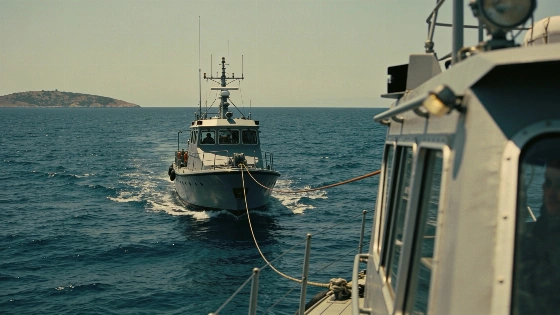
The Commission's 2026 assessment cites Turkish objections to the Greece-Cyprus electricity link and the unresolved threat of force against Greece, while reaffirming EU rejection of the Turkey-Libya maritime memorandum.
Turkey's alignment with the European Union's Common Foreign and Security Policy stood at 4%, while its accession negotiations have been at a standstill since 2018, according to the European Commission's latest assessment. The report, released on Wednesday, November 4, 2026, places disputes involving Greece and Cyprus alongside wider concerns about Ankara's relationship with the EU. The Commission's Türkiye Report 2026 forms part of the annual Enlargement Package adopted that day.
Pagenews.gr reports that the assessment was issued as part of the EU Enlargement Package. It recognises Turkey's strategic importance in migration, regional security, trade and connectivity while recording unresolved disagreements over maritime jurisdiction and Cyprus. The Commission continues to classify Türkiye as an EU candidate country and a strategic partner, but says the conditions underlying the accession standstill remain. The package does not reopen negotiations; it describes relations as proceeding on a phased, proportionate and reversible basis.
The wider package covered nine candidate countries and one potential candidate country. In its assessment of Türkiye, the Commission addressed foreign-policy alignment, rule of law, bilateral disputes and cooperation in areas including migration, trade, transport and energy. It also noted concerns relating to judicial independence, media freedom, LGBTIQ rights and local democracy.
The interconnector and maritime memorandum
The Commission says Turkey continued to obstruct survey activities for the Great Sea Interconnector (GSI), a project intended to connect Cyprus to the European electricity network through Greece. The EU has designated the project a Project of Common Interest. The report records the obstruction but does not announce new sanctions or a mechanism to ensure survey work can proceed.
The assessment also reiterates the EU's rejection of the 2019 Turkey-Libya maritime memorandum. Libya's eastern-based House of Representatives ratified the agreement in Benghazi on October 20, 2026. The Benghazi vote was also covered in earlier reporting, which noted that the endorsement widened the memorandum's political backing without resolving rival claims.
The Commission says the memorandum infringes the sovereign rights of third states and is incompatible with the law of the sea. In a joint statement on October 20, European Council President António Costa and European Commission President Ursula von der Leyen called it "null and void." Greece argues that the agreement disregards the rights of its islands; Turkey maintains that it reflects its legitimate maritime entitlements. The EU's position does not itself prevent Ankara from pursuing activities based on its own interpretation.
The unresolved threat against Greece
The report recalls the Turkish parliament's 1995 declaration threatening war if Greece extends its territorial waters in the Aegean to 12 nautical miles. Article 3 of the United Nations Convention on the Law of the Sea provides for territorial seas extending up to that distance. Turkey is not a party to the Convention, while Greece says the 12-nautical-mile rule also forms part of customary international law.
Greece regards an extension as a sovereign right. Turkey opposes it in the Aegean, citing the consequences for its interests and access to maritime spaces. The Commission does not settle the dispute, but says the continuing threat is a serious obstacle in relations with an EU member state. The parliamentary declaration has not been withdrawn despite improved Greek-Turkish relations since 2023.
The Commission also records Turkish military overflights above Greek islands, including inhabited ones, and reported violations of Greek airspace and territorial waters. It says incidents occurred as recently as September 2026. The report notes concern about the Blue Homeland doctrine, or Mavi Vatan, appearing in Turkish school textbooks, as well as Turkish positions challenging Greek sovereignty and jurisdiction.
Brussels points to legal and peaceful channels
The Commission calls on Turkey to demonstrate an unequivocal commitment to good-neighbourly relations and international law, including peaceful settlement of disputes. It refers to the possibility of taking disputes to the International Court of Justice in The Hague where appropriate. That does not mean Greece and Turkey have agreed to bring their disagreements before the Court.
Greece has identified delimitation of the continental shelf and Exclusive Economic Zone as the central legal dispute suitable for adjudication. Turkey has sought to place a wider range of issues on the bilateral agenda. A case brought by special agreement would require both parties to agree on the dispute submitted.
On Cyprus, the Commission criticises Ankara's support for a two-state settlement and its non-recognition of the Republic of Cyprus. The EU says the Republic is the island's only internationally recognised state and calls for a comprehensive settlement under UN auspices. The report also addresses unilateral actions in Varosha and Turkey's military presence on the island. It cites a July 2026 memorandum with the internationally unrecognised entity in northern Cyprus for a subsea natural gas pipeline, signed without the Republic of Cyprus's consent.
The assessment further records Turkey's objections to a Patriot air-defence system on Karpathos and Greek F-16 aircraft in Cyprus during the security crisis linked to developments in the Middle East. It also notes disputes over Greek marine parks and maritime spatial planning. In the joint statement issued after the Libyan parliament's vote, Costa and von der Leyen said: "We reaffirm our solidarity with Greece and Cyprus."
At a press conference accompanying the package, High Representative Kaja Kallas said that taking EU-Türkiye relations further, including closer security and defence cooperation, requires the agreement of all member states. She acknowledged that some capitals oppose deepening the relationship. The Commission's approach therefore keeps practical engagement in shared-interest areas separate from progress on accession and deeper institutional cooperation.
Commissioner for Enlargement Marta Kos and Kallas described Türkiye as both a candidate country and a key partner. The Commission identified migration, trade, transport and energy as areas of shared strategic interest, while maintaining that the political and institutional conditions behind the accession standstill remain in place.







