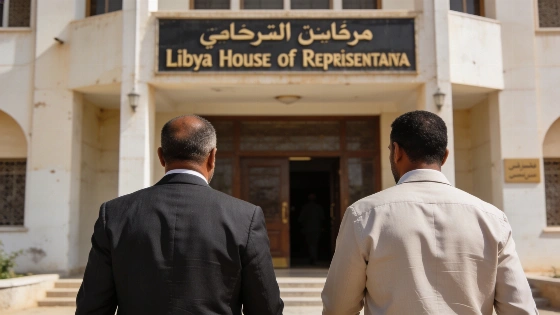
Libya's eastern parliament has endorsed Ankara's 2019 maritime memorandum, widening its political backing without settling rival claims or authorizing drilling. Israel and its partners now face more complicated diplomacy in the Eastern Mediterranean.
The eastern Libyan chamber spent years treating Ankara's 2019 maritime memorandum as a red line. On October 20, it unanimously endorsed the deal and repealed Decision No. 1 of 2020, which rejected the maritime and security memoranda, and Decision No. 6 of 2020, which severed political relations with Turkey. House spokesperson Abdullah Bliheg said the chamber had unanimously approved the memorandum.
The agreement was signed in Istanbul on November 27, 2019, by Turkish Foreign Minister Mevlüt Çavuşoğlu and Mohamed Taher Siala, foreign minister of Libya's former Government of National Accord. It was registered with the United Nations on December 11, 2019. The eastern parliament's vote means both Libya's eastern and western political authorities have now endorsed the same maritime instrument, while its legal effect remains contested.
The consequences were visible beyond Libya within two days. Greece and Egypt's foreign ministers publicly discussed extending their 2020 exclusive economic zone agreement eastward toward Cyprus, explicitly linking the talks to the Libyan vote. Greece called the arrangement a violation of international law, information from Reuters. Egypt's Foreign Ministry said the memorandum was null and void and had no legal effect for Egypt. The shift matters to Israel because maritime claims touch its partnerships and regional strategic assets, including potential energy projects and undersea infrastructure carrying data and power.
Political backing changes the negotiating field
The vote does not settle competing maritime claims or authorize drilling. It gives Ankara a stronger political argument: support for the memorandum now comes from Libya's east as well as the western authorities that signed it.
Türkiye welcomed the vote as confirmation of an agreement it considers already in force. Its Foreign Ministry said the memorandum safeguards the mutual rights and interests of both countries on the basis of international law and equity. That position has not removed objections from Greece, Egypt, Cyprus, Israel or the European Union.
That distinction is basic. The 2019 memorandum and a separate 2025 study agreement between Libya's National Oil Corporation and Turkish Petroleum Corporation, or TPAO, are different instruments. Any exploration would still depend on licenses, the proposed location and applicable legal and political constraints.
Greece argues the 2019 line disregards the maritime rights of its islands, including Crete and the Dodecanese. Egypt and Cyprus have also objected, as have Israel and the European Union. Turkey and Libya defend the arrangement as consistent with international law and their national interests. Registration with the United Nations does not make every claim binding on third states.
Leadership and commercial ties help explain the shift
The parliamentary reversal followed a change at the top. On October 6, lawmakers elected Al-Salhin Abdelnabi al-Obeidi as speaker, replacing Aguila Saleh after nearly 12 years. The previous day, 98 lawmakers had approved rules limiting the speaker and deputies to 12-month terms.
Al-Obeidi had chaired the House's Libyan-Turkish Parliamentary Friendship Committee. That connection is relevant, though it does not establish that he engineered the vote. Saleh had faced criticism from colleagues, and the leadership change altered the chamber's political setting without explaining every lawmaker's decision.
Two Libyan lawmakers told Reuters the maritime agreement could bring strategic advantages across economic and political affairs, including national security. Economic contacts had also been developing. In July, the eastern-based Libyan National Army's General Command announced a contract with Turkish company Akteknik for an integrated land-border management and surveillance system. Its first phase covered 275 kilometers under the force's Vision 2030 program, supervised by deputy commander Saddam Haftar. The contract concerned land-border monitoring; it granted no maritime drilling rights and offered no evidence of Turkish military bases in eastern Libya.
On June 25, 2025, Libya's National Oil Corporation signed a memorandum with TPAO for geological and geophysical studies in four offshore areas. The announcement also referred to discussions about a two-dimensional seismic survey covering 10,000 kilometers. The memorandum did not authorize drilling in every disputed block, but it established a basis for further commercial cooperation.
These developments offer context for eastern leaders seeking investment and use in talks over Libya's future. Turkey has long held influence in western Libya and has cultivated contacts in the east. Washington continues to press rival Libyan centers toward a political and institutional settlement. No single bargain has been established as the cause of the parliamentary vote.
Israel needs coordination grounded in evidence
September reports suggested that Benjamin Netanyahu may have met Saddam Haftar in the United Arab Emirates. Flight-tracking data reportedly showed a plane associated with Saddam Haftar arriving in Abu Dhabi while Netanyahu was visiting. Neither government confirmed a meeting, and no public evidence shows that Haftar promised to contain Turkey or that Israel secured a strategic commitment.
The report cannot establish that the vote was a betrayal. A previous assessment likewise described the endorsement as political use rather than a resolution of Greece's objections or an authorization to explore.
Israel should coordinate a shared legal assessment with Athens and Nicosia while bringing Cairo into the effort. Mapping contested zones and documenting third-party rights would give the partners a common position to present to the United Nations and European capitals, even where their broader interests diverge.
Maritime information-sharing should cover seismic vessels and exploration activity, as well as offshore installations and undersea cables. The immediate priority is timely information and agreed responses to incidents. Israel can also press European partners for transparent licensing procedures consistent with international law and make a precise case to Washington about threats to agreed rights and regional infrastructure.
Jerusalem should keep channels open in both eastern and western Libya without treating either side as a single actor. The House has competing factions, and personal assurances from one figure cannot substitute for commitments that survive leadership changes.
The endorsement has widened political support for cooperation with Ankara. It has not settled the law or authorized immediate drilling. The Libyan News Agency's account of the vote records the chamber's approval of the memorandum and repeal of the two 2020 decisions.