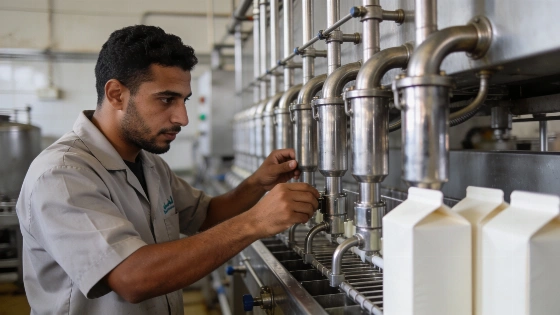
Libya's cereal import needs are forecast at 3.3 million tonnes for 2026/2027 as food inflation strains household purchasing power. Zulfa's planned Benghazi dairy facility shows how local processing could expand capacity.
Zulfa Food Industries is developing a dairy and juice processing facility in Benghazi, but Alushibe's updates describe a project being prepared for operations rather than a plant already in commercial production. Work has included factory finishing and coordination of the site's utility and electrical infrastructure, including piping, ahead of equipment installation. Ahmed Gadalla, chairman of Alushibe Holding Group, has also reported the installation of transformers and security systems at the site.
The Food and Agriculture Organization's July 2026 country brief forecasts cereal import requirements of 3.3 million tonnes for the 2026/2027 marketing year, nearly 7% above average after difficult weather conditions. It also reported food inflation of about 18% year on year in May 2026, largely reflecting the dinar's depreciation and higher costs for imported food. The FAO's October price monitoring later reported monthly increases of 10% to 43% for wheat flour, whose supply is heavily dependent on imports. Sorghum prices rose by 38% to 75%, while millet prices climbed by 21% to 88% across monitored markets. The agency has traced Libya's sustained cereal-price rise, which began in late 2017, to macroeconomic pressures and high fuel and agricultural-input costs that raise production and transport expenses.
Import dependence reaches beyond farms
For households, food on supermarket shelves may still become harder to afford. For businesses, the import bill also points to potential opportunities across the local food chain, including processing and storage, as well as packaging and transport. Libya will continue to rely on international suppliers; the question is how much more of the food supply chain can operate locally.
An Africa Center for Strategic Studies analysis dated November 4 said that "conflict continues to be the primary driver of acute food insecurity in Africa". It estimated nearly 164 million Africans face acute food insecurity, around 80% of them in conflict-affected countries. Nigeria and the Democratic Republic of Congo, together with Sudan and Ethiopia, account for approximately 60% of that total. Libya's circumstances differ from the continent's most severe hunger emergencies, but the figures underline how food access depends on systems that keep supplies available.
The FAO has also linked recent pressure on Libyan cereal prices to political instability since 2019 and conflict since April 2023. Its analysis also cites reduced cereal production in 2025, alongside concerns about rainfall for the 2026 harvest. Its October assessment said coarse-grain prices were about 16 times, and wheat-flour prices about 10 times, their March 2023 pre-conflict levels. The agency's October price warning also noted the role of fuel and agricultural-input costs in production and transport.
The FAO figures place food prices, supply and purchasing power alongside the production and logistics decisions facing businesses. Investment choices in processing need to account for production costs and consumer demand, as well as water availability and the reliability of imports.
Zulfa's planned role in Benghazi
Zulfa is a subsidiary of Alushibe Group. The project, announced in July 2025, is being developed with Tetra Pak processing and packaging technology. Its planned first phase includes mixing systems, UHT treatment and pasteurization, with three production and filling lines.
Ahmed Gadalla took part in further discussions between Zulfa and Tetra Pak in October, according to a company update dated October 23. The update described preparations for the Benghazi operation and discussions about future products and cooperation; Alushibe's project updates describe the facility as moving from construction toward preparation for production. The project fits the broader local investment described in an earlier business profile.
Alushibe's corporate biography says the group began as an automotive-parts business with one small store in Benghazi and was formally established in 2008. The group describes its activities across several sectors, including consumer goods and industry, as well as engineering, healthcare and retail. It reports more than 6,000 employees and service to over 2 million customers across Libya. Zulfa forms part of this wider expansion into industry and food manufacturing.
A processing facility requires expertise in maintenance and quality control, alongside purchasing and distribution. Those functions can create opportunities for Libyan workers and suppliers as operations develop. Storage and dependable transport can also help producers reach customers beyond the city where a factory is based.
Conditions for domestic investment
Food manufacturers need reliable electricity and access to equipment and spare parts. Financing and import arrangements matter too. Public institutions can support investment through clear food-safety standards, backed by consistent enforcement.
Affordability remains central: domestic capacity contributes to food security when consumers can trust and afford the products. Processing businesses will also retain dependencies on imported ingredients, machinery or packaging materials. Alushibe's October update said Gadalla and Tetra Pak representatives discussed future products and cooperation.