Algeria's dairy build-out combines Baladna's US$3.5 billion Adrar complex with Giplait's expanded Rouiba plant. The projects aim to raise local milk output and reduce dependence on imported powder.
At full development, the Adrar complex is designed to produce about 1.7 billion litres of milk a year and accommodate up to 270,000 cows. Construction is under way on the US$3.5 billion project, which could eventually meet up to 50% of Algeria's powdered-milk demand. Baladna-linked project materials also describe a planned processing facility with capacity for 198,000 tonnes of milk powder annually, a separate measure from the complex's liquid-milk output.
Giplait's expanded Rouiba plant adds more than 1.2 million litres of daily processing capacity near Algiers. Together, the projects put domestic production and processing central to Algeria's effort to reduce reliance on imported milk powder, with supply logistics also part of the plan.
Adrar project combines farming and processing
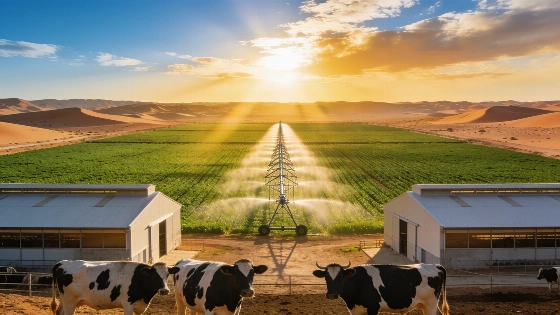
The joint venture brings together Qatar's Baladna, with a 51% stake, and Algeria's National Investment Fund, which holds 49%. The project is designed to link cereal and fodder cultivation with cattle farming, milk production, powdered-milk processing and meat production. Baladna's project materials describe three operating sites in southern Algeria, centred on Adrar, across approximately 117,000 hectares. Its planned 117,000-hectare site in Adrar province links fodder and maize cultivation with dairy farming, powdered-milk processing and meat production. First milk production is targeted for late 2027.
Two construction packages announced so far exceed US$1.1 billion in total contract value. Phase one, signed in 2025, exceeded US$500 million. The second package, worth more than US$635 million, was signed in Algiers on 24 April 2026 and covers civil works, irrigation, earthworks and staff accommodation. Seven of the ten companies involved in the second phase are Algerian. CRCEG has a civil-works role, while GCB SPA is handling dairy-farm construction. SAPCI is assigned concrete works.
The project targets 40% completion by the end of 2026. Baladna's plan also calls for 30,000 Holstein cows sourced from nine US states: Arizona, New Mexico, Texas, Colorado, Idaho, California, Kansas, Iowa and Indiana. They will be transported through a 109-flight programme over about ten months. The first cattle were expected in Adrar on 25 November 2026, and the delivery programme is scheduled to begin in November. The company estimates the procurement and logistics activity will generate US$250 million to US$300 million in the United States and create about 1,200 jobs there. It projects more than 15,000 jobs in Algeria during execution.
In a November 2026 update, Baladna Food Industries CFO and CIO Saifullah Khan reported that 59 water wells had been completed, 32 irrigation pivots were operational and approximately 420 hectares had been cultivated. He also said construction had begun on the dairy farms and manufacturing facilities, as FoodNavigator reported. The initial US cattle deliveries are to be made by air from suppliers across the nine states. Facilities have been prepared to receive the animals.
Water and power are essential to the Adrar model
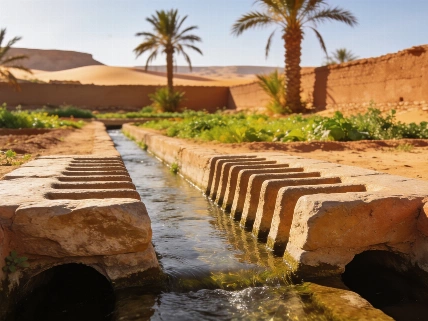
Fodder production in the Sahara depends on irrigation and reliable electricity. Valmont is supplying irrigation and water-management technology; phase one includes 700 of 1,400 planned central-pivot systems drawing on underground aquifers. Green Power Systems has supplied 50 generator sets rated at 330 kVA. Each is powered by an FPT engine and will operate irrigation systems continuously.
A separate Sonelgaz electricity-expansion programme is being developed to serve three major agro-industrial projects in the south, including Baladna's Adrar complex. Figures attributed to transmission manager GRTE call for 1,237 kilometres of overhead lines and 10 transformer substations across the programme. Baladna's share comprises 767 kilometres of lines and eight dedicated substations. The stated objective is to ensure energy autonomy for the three agro-industrial projects.
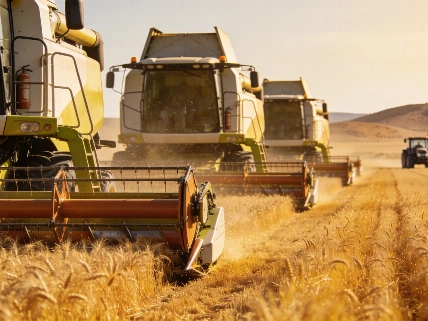
The integrated design connects crops and livestock with processing at one site. That could create demand for farm equipment and maintenance, alongside technical services for the construction programme.
Rouiba expands Giplait's operating capacity
Giplait's Rouiba plant was inaugurated on 19 February 2026 by Agriculture Minister Yacine El-Mahdi Oualid and Trade Minister Amel Abdellatif. The four-hectare site is about 20 kilometres east of Algiers. Its capacity exceeds 1.2 million litres a day, including about 1 million litres of pasteurised milk sold at regulated prices, plus a new UHT line.
Giplait operates 17 subsidiaries and holds about 52% of Algeria's pasteurised milk market. It collects an average of about 550,000 litres of cow's milk daily. Collection has risen 52% since the group introduced partially skimmed milk in sachets in 2024. Its network includes 1,077 affiliated distributors, and its annual milk production capacity is about 2.2 billion litres.
The group is also pursuing product partnerships. In February 2026, it signed an agreement in Belarus with Bellakt to produce infant milk in Algeria using technology transfer at Rouiba. Russia's EkoNiva met Giplait in January to explore potential investment; the discussions remain exploratory, with no investment amount or capacity specified. Giplait has also outlined plans to export products such as cheese as domestic capacity grows.
Import dependence remains the market test
FAO data compiled by Uruguay's National Institute of Dairy put Algeria's average dairy imports at about 431,270 tonnes a year from 2020 to 2024, with an average annual import bill of about US$1.61 billion. Agriculture Minister Yacine El-Mahdi Oualid has put per-person milk consumption at about 145 litres a year, compared with a global average of about 90 litres.
Industry data show dairy import spending of about US$398 million from January to April 2026, down 13% from the same period a year earlier. An earlier fiscal analysis examines the broader fiscal and private-sector context for Algeria's economic diversification.
USDA agricultural reporting lists state support of DZD 12 per litre for dairy-cattle breeders and DZD 5 per litre for milk collectors, alongside a DZD 60,000 payment for each new dairy-cow birth.