
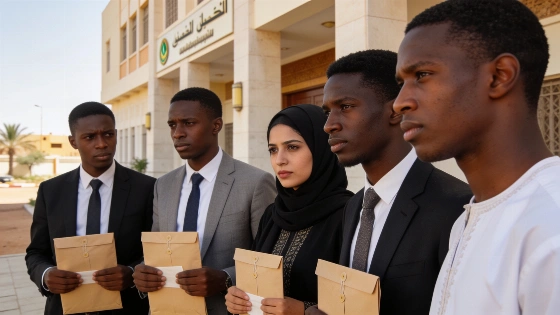
Graduates from the Islamic Economics section of Mauritania's ISERI have formally requested to be allowed to compete in the national magistrate recruitment exam, arguing their exclusion contradicts legal eligibility criteria and past precedent.
Graduates of the Islamic Economics section at the Institut supérieur d'études et de recherches islamiques de Mauritanie (ISERI) have called on the Minister of Justice and the President of the Supreme Court to intervene after being excluded from the provisional list of candidates for the national magistrate recruitment exam.
In a formal complaint, the graduates argued that their section is part of ISERI's Sharia track and that their exclusion contradicts the legal requirements for candidacy. They referenced a Supreme Court administrative chamber decision (No. 10/2026, dated 13 April), which addressed a similar appeal from students in the Foundations of Religion section. According to the graduates, this decision clarified that Article 21 of Organic Law No. 012/94, which governs the magistracy, requires candidates to hold a master's degree in law or Islamic Sharia, or an equivalent qualification, without specifying a particular specialization within the Sharia track.
Legal Basis and Precedent
The graduates maintain that the law does not explicitly restrict eligibility based on specialization within the Sharia field. They argue that, as their studies focus on the law of transactions and contemporary economic issues, their training provides relevant legal knowledge for judicial work. They also noted that graduates from their section have previously participated in magistrate recruitment exams and some have joined the judiciary, suggesting that their current exclusion lacks legal foundation.
Implications for Judicial Recruitment
This dispute highlights ongoing debates over eligibility criteria for judicial positions in Mauritania, particularly regarding the recognition of specialized Islamic academic qualifications. The outcome may affect future access to the judiciary for graduates of non-traditional legal disciplines within the Sharia framework. The Ministry of Justice and the Supreme Court have not yet publicly responded to the graduates' request.