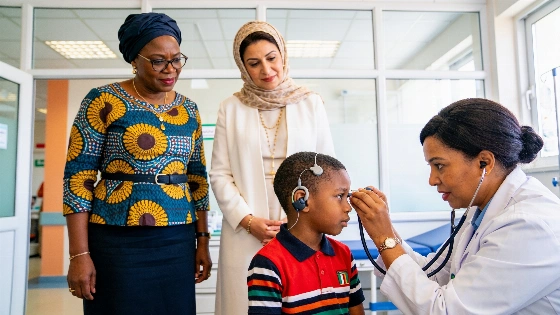
Kenya and Morocco are strengthening their healthcare ties as First Lady Rachel Ruto visits Rabat to review and grow a cochlear implant programme for children, with an emphasis on training and making treatment more accessible for Kenyan families.
Kenya's efforts to help children with hearing loss have taken a step forward with First Lady Rachel Ruto's visit to Morocco on 14 September 2026. Her stops in Salé and Rabat were confirmed by both Morocco World News and Le360 Afrique. The trip aims to strengthen the partnership between the two countries and secure the next phase of a cochlear implant programme. For many Kenyan families, access to these surgeries depends on how well this cross-border effort holds up, a point noted by regional outlets like the Maghreb Arab Press (MAP).
Rachel Ruto was welcomed by Princess Lalla Asmaa, continuing a collaboration that began with the Princess's visit to Nairobi in November 2025. At that time, her foundation donated cochlear implant devices worth over Ksh 120 million, making it possible for dozens of Kenyan children to receive surgeries that were previously out of reach. This partnership has been covered by specialist outlets such as Deaf Navi World-JP and fits into Morocco's broader disability inclusion work, with the Ministry of Solidarity, Social Integration and Family playing a central role.
Programme expansion and the cost barrier
The Voice of Children initiative goes beyond charity. Each cochlear implant surgery costs more than Ksh 4 million, a price that most Kenyan families cannot afford. The Moroccan donation was only a starting point. Now, the focus is on reviewing results, reaching more children, and making sure the technology and expertise are not limited to a small group. The Moroccan Ministry of Health and Social Protection has expressed support for expanding these cross-border medical projects, as reported by MAP and in recent African Union health updates.
Rachel Ruto has made it clear that the goal is to create more opportunities and inclusion for children with hearing loss. The Kenyan Ministry of Health is working to add cochlear implantation to national health policy, using the Social Health Authority (SHA) to cover both surgery and the necessary rehabilitation. The SHA is introducing new provider contracts and tariffs from 1 October 2026 to 30 June 2029, which could be important if cochlear implants are to be included in reimbursement rules, according to LiveNow Africa and recent SHA statements.
Skills transfer and building local capacity
Supplying devices is only part of the solution. The Kenya-Morocco partnership has focused on training, with Kenyan ENT surgeons, audiologists, and speech therapists receiving advanced instruction at hospitals such as Kenyatta National Hospital, Kenyatta University Teaching, Referral and Research Hospital, Moi Teaching and Referral Hospital, and MP Shah Hospital. This approach aims to reduce Kenya's reliance on sending patients abroad and to build up local expertise for complex procedures. In April 2026, the two governments signed 11 Memoranda of Understanding covering health, local manufacturing, and specialist training, as confirmed by both ministries and reported by the Maghreb Arab Press.
This visit is meant to review how these agreements are working in practice and to secure further commitments for medical exchanges and supply chains for implant devices. Kenya's Social Health Authority, now covering more than 29 million Kenyans, faces pressure to make expensive treatments like cochlear implants more widely available while also improving oversight, as reported by Kenya News and regional health policy analysts.
Diplomatic context and regional impact
While the cochlear implant programme is the main focus, the wider diplomatic relationship matters too. The 11 MoUs signed in April 2026 cover areas from manufacturing to agriculture, showing that both governments want to deepen ties beyond symbolic gestures. The Ministry of Health has said that real skills transfer, not just equipment donations, is the measure of success. This approach is similar to Morocco's broader strategy in areas like defence and energy, as reported by the Maghreb Arab Press and the African Union Commission.
Kenya's efforts also fit with its new health financing system, which sets SHA contributions at 2.75% of gross monthly pay in the formal sector, with a minimum of 300 shillings and published benefit ceilings as of February 2026. This setup is meant to make advanced treatments like cochlear implants available to more people, not just a select few, and is being watched by regional health ministries and the UN Economic Commission for Africa (UNECA).
What comes next
The immediate challenge is to secure ongoing funding and supply for cochlear implants and to keep building the training pipeline for Kenyan medical staff. The government's promise to cover the full cost of surgery and rehabilitation through the Social Health Authority will be tested as the programme grows. The strength of the Kenya-Morocco partnership will depend on whether these plans lead to regular access for families across the country, not just one-off events.
Kenya's move to include advanced medical procedures in its national health system, with support from Morocco, is a rare example of cross-border cooperation leading to real results. If the current pace continues, this could become a model for regional partnerships in specialised healthcare. The real measure will be whether many more children gain access to hearing, not just a handful. Anything less would fall short of the programme's promise.