
From 5 to 7 October, Morocco Design sent visitors across Casablanca, linking local craft with contemporary design while raising a harder question: can cultural platforms sustain work for designers and artisans at home?
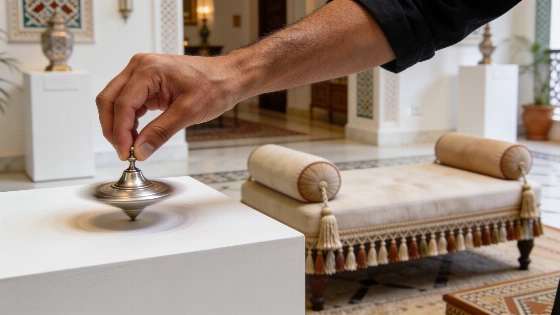
A silver spinning top set the tone at the Fondation Alliances headquarters in Casablanca. Designer Othmane Bengebara spun the toy beside his ottoman, Irtah!, and described the appeal of its movement: "I love the tension," he said.
The private villa opened to the public for the first time during the inaugural event, held from 5 to 7 October. Bengebara's piece belongs to Futur Arab Tales, a project about the relationship between Arab craftsmanship and narrative. Its first tale, "The man and the spinning top," imagines a figure who must decide before the toy stops. The low-slung ottoman offers a place to rest. Its rounded cushions and tassels draw on regional seating traditions, while legs shaped like spinning tops suggest levitation. The title's exclamation mark turns rest into an imperative in a culture of constant motion.
That tension between continuity and change ran through the programme. Rather than concentrating the event in one pavilion, its first edition created a route through Casablanca. Fondation Alliances and Flexform were among the stops, as was Villa Sahrai. Visitors could also go to Loft Art Gallery. ETC Collection and Teatro Italia completed the route. The format brought audiences into working studios, then opened galleries and historic spaces across the city.
At Flexform, Saad Filali, founder of The Zellijist, demonstrated zellige craftsmanship and spoke about leaving a career in law for creative design. Guests could try assembling the clay pieces in a hands-on workshop. At Villa Sahrai, Sophia Kacimi remade the sofa as sculpture using familiar Moroccan home fabrics. Fabric-covered foam blocks rose from wooden bases in totemic forms. "The starting point is always craft," she said, describing work made with carpenters and a family she has partnered with for four years.
Amina Agueznay's woven designs tied contemporary art to labour and place. In the Amazigh village of Tissekmoudine, artisans removed palm bark and separated it into fibres before weaving. At Loft Art Gallery, Agueznay was presented in the exhibition Hamasāt al-Fajr on 7 October. She said the fulfilment came not from publicity but from working "in the field" with female artisans: "It's always the intangible."
Agueznay's later selection for Morocco's first national pavilion at the 61st Venice Biennale took that local collaboration onto an international platform. The project, Asǝṭṭa, followed a national competition launched in 2025. Meriem Berrada served as pavilion curator. RFI reported that Agueznay worked with around 100 Moroccan weavers on the installation, scheduled to be presented during the Biennale through 22 November 2026. Her Venice selection does not establish a direct impact from Morocco Design. It does show how craft-based practice can reach international cultural institutions through local collaboration.
At Loft Art Gallery, Mous Lamrabat's photographs placed Amazigh references in sharply contemporary compositions. In WhatsApp, 2022, a woman's henna-covered palms carry the WhatsApp logo. Luv Ryders, 2021, shows a figure in a red-heart-spattered white burqa on horseback in the desert. The gallery also showed paintings and mixed-media work by Jouana Choumali and Walid Ardhaoui alongside Agueznay's woven pieces.
Morocco Design also brought visitors to Teatro Italia, where Hamza Kadiri's exhibition L'Axe Invisible ran from 5 to 7 October despite the historic building's ongoing restoration. At Roche Bobois, a dinner marked three decades of Hicham Lahlou's work. The presentation included amber oryx figures and "disco pipes." It also featured watches made with LIP and a sculptural teapot paying tribute to Zaha Hadid. Meryam Lahlou showed brutalist pieces at ML Ateliers. Côté Bougie presented its olfactory creations.
Founder Hanane El Moutii called the project "my love letter to Morocco." The Italian-born Moroccan entrepreneur, who founded Los Angeles-headquartered PR firm Eclat, began developing the idea in 2019. A separate industry analysis examined whether infrastructure spending can build domestic engineering. Morocco Design puts a cultural version of the local-capability question before audiences through designers, studios and artisans.
That economic question needs care. A design event can create visibility and opportunities for collaboration, but its programme alone cannot establish the scale of local procurement, employment or exports. Morocco's MAP is a national news agency. Algeria's APS and Tunisia's TAP are national news agencies too. The UN Economic Commission for Africa offers a broader regional economic perspective. Those institutional frames help distinguish cultural promotion from comparable economic indicators, but they do not quantify the event's results. Morocco's MAP and UNECA's regional work offer wider contexts for reporting on national and regional developments.
El Moutii wants the event on the international calendar alongside Salone del Mobile in Milan and Maison&Objet in Paris. That ambition does not establish Morocco Design as a global design fair. Its first edition gave Moroccan creators a home-ground platform and tied contemporary work to specific craft traditions. International visitors encountered that work in Casablanca. For the country's design scene, the next step is sustaining the platform at home. El Moutii wants Morocco Design on the international calendar alongside Salone del Mobile in Milan and Maison&Objet in Paris.