
Dr Safia Benamar's survey of 123 Moroccan ophthalmologists and trainees found widespread instrument reuse, alongside infection concerns and training gaps. Historical data and an Indian comparison frame her planned audit of emissions and costs; it will also measure packaging waste.
Among 123 respondents, 81% reported using reusable instrumentation in cataract surgery. The survey, presented by ophthalmology resident Dr Safia Benamar, also found that infection concerns and gaps in training remain major obstacles to reducing waste.
Benamar called the questionnaire Morocco's first local snapshot of sustainability practices in cataract care. It drew responses from ophthalmologists and trainees working in the country.
Another 75% said they reused phacoemulsification cassettes. Meanwhile, 71% reported more than three follow-up appointments after surgery, and 68% prescribed three or more postoperative eye drops.
The stakes extend beyond individual clinics. Cataract surgery is the world's most common ophthalmic procedure, with about 30 million operations each year. Benamar cited healthcare's responsibility for 5% of greenhouse emissions. She also noted how sharply an operation's carbon footprint can vary by care model: one phacoemulsification in the UK generates roughly 20 times the emissions of the same procedure at India's Aravind Eye Care System.
A CRST Global account of an Aravind assessment conducted between November 2014 and February 2015 put the waste from one phacoemulsification at about 250 grams. Its emissions came to roughly 6 kilograms of carbon-dioxide equivalent, around 5% of the comparable UK procedure's footprint. The assessment linked the lower impact to reuse: gowns and caps were reused, as were overshoes and instruments. Multi-dose medicines and more efficient sterilisation also featured in the assessment. Its vehicle-travel comparison was about 14 miles for the Aravind procedure versus 391 miles for the UK procedure. Those figures compare the study's settings; they are not universal estimates for every hospital.
Benamar also pointed to Aravind's use of renewable energy. The network uses reusable instruments and supplies, and has water and waste management measures in place. It has been reported to perform roughly 750 to 1,500 cataract operations a day.
Benamar cited a reported postoperative endophthalmitis rate of 0.01% across more than a million consecutive procedures, lower than the rate reported by the US. Separately, published findings covering two million consecutive Aravind cataract operations associated intracameral moxifloxacin with a lower risk of sight-threatening postoperative endophthalmitis. A review described the reduction as potentially reaching sevenfold. Those findings do not, by themselves, establish that a particular reuse practice is safe in another clinical setting.
Only 31% of survey respondents agreed that cataract surgery generates excessive waste. Asked what stands in the way of reducing it, 48% cited infection concerns and 43% pointed to a lack of training.
Benamar said endophthalmitis is rare but can cause blindness, so clinicians' caution is understandable. She said regulation affects practice. Industry pressures and financial considerations matter too. Perceptions of safety also shape decisions.
The issue sits within a wider Moroccan resource challenge. A recent infrastructure analysis identified water constraints as a factor in the country's effort to turn public investment into domestic capacity. Historical estimates put Morocco's cataract surgical rate at about 768 operations per million people, compared with an indicative World Health Organization benchmark of 3,000 per million for Africa. The figure appeared in a 2006 publication, so it is not a current rate. It does show why sustainability measures need to be considered alongside access to care.
Morocco's Ministry of Health and Social Protection continues to publish notices about cataract-surgery campaigns, including activity in Rhamna province and at the Moulay-Abdellah provincial hospital in Salé. The ministry's campaign notices document service activity. They do not report results from Benamar's waste survey or announce a new national rule on reuse of surgical consumables. The notices also provide no provider-level figures on materials or costs, and do not quantify environmental impact.
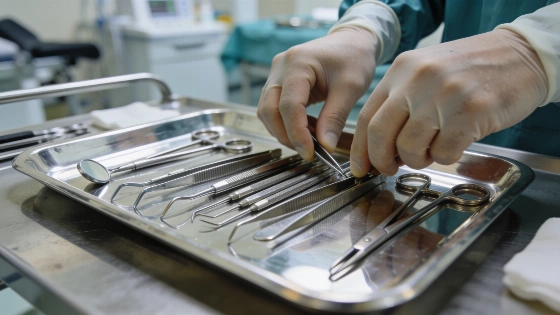
Benamar wants providers to review cataract instrument trays and remove items that are opened but rarely used. She also sees fewer unnecessary postoperative drops and visits as practical targets. Evidence does not consistently show that more drops or appointments improve outcomes, she noted. Any reduction would need to be assessed against clinical protocols and patient needs.
Her next step is an audit across multiple public and private cataract providers in Morocco. It will measure costs and carbon emissions, then track packaging waste. Benamar aims to document practices that may already be working, including the use of multi-dose iodine bottles. The audit will also quantify the environmental and economic burden of excessive eye-drop prescribing.