

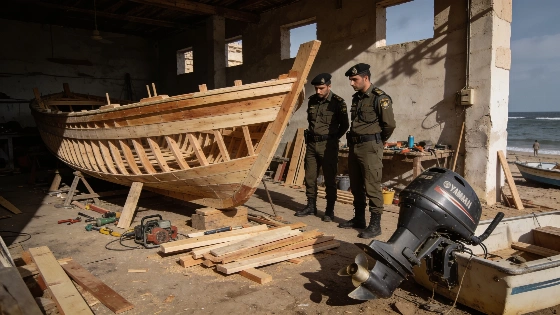
Libyan security forces have uncovered hidden workshops making boats for migrant crossings to Europe. Officers have seized vessels and burned parts to break up the supply chain behind the so-called 'boats of death.'
Libyan authorities have stepped up their fight against the underground industry that builds boats for irregular migration. Security teams have raided hidden workshops along the coast and destroyed seized vessels, trying to cut off what locals call the "boats of death." The Libyan News Agency (LANA) confirmed these latest operations. They revealed a wide network of production sites, from carpentry shops in Zuwara to makeshift setups in Tobruk and Sirte. All of them are focused on building boats for the dangerous trip across the Mediterranean. In early September 2026, security forces found at least two secret boat-building sites in Tobruk and Sirte. They seized boats and equipment in coordinated raids officially reported by Libyan authorities and backed up by regional media.
During these raids, officers found wooden planks, engines, and boat-building tools. They also came across finished and half-built boats. In some cases, security forces burned the confiscated boats and parts right on the spot. The goal was to keep them from ending up back in the smuggling trade. Reports from Asharq Al-Awsat and the Tunis Afrique Presse (TAP) agency have described this approach. It matches a wider regional pattern of direct action to break up illegal maritime supply lines.
Coastal workshops and supply chains
The Benghazi Center for Migration Studies says these secret workshops cluster in coastal cities near main departure points. Some are just steps from the sea, set up in simple buildings. Others hide inside regular carpentry businesses. Authorities in Zuwara recently found a coastal site turned into a wooden boat factory. This adds to a growing list of locations found in Tajoura near Tripoli, Khoms, Al-Qawiyah, and Misrata. The Center reports that the eastern region-especially Tobruk, Bir al-Ashhab, and areas near the Egypt border-has become a new hotspot for these operations. The Algerian Press Service (APS) has also noted this trend in its coverage of regional migration.
These workshops turn out all kinds of vessels: wooden and fiberglass boats, inflatable craft, and even old fishing boats refitted for the journey. More and more, boats are built just for migrant crossings, often with little attention to safety. The ongoing presence of these workshops in both western and eastern Libya, as shown in several independent reports, points to a network that adapts and survives, not just a few isolated cases.
Financial networks and operational risks
The supply chain behind these boats is organized and well-funded. Tarek Lamlum, who leads the Benghazi Center for Migration Studies, describes a network that stretches across Libya. It involves financiers, builders, importers, transporters, and people who provide captains and secure launch sites. A security source quoted by Asharq Al-Awsat says a good wooden boat without an engine can sell for about 50,000 Libyan dinars-roughly $5,000. This shows how profitable the trade has become. The International Organization for Migration (IOM) reports that Libya is still a major transit hub, with about 936,000 migrants in the country during January and February 2026. This highlights the scale of the problem facing authorities.
Libyan authorities have ramped up their crackdown on these workshops. But the root causes-regional instability, economic hardship, and the pull of Europe-are still there. Destroying boats may slow things down for a while, but as seen in other sectors, like the commercial transport market described in a reported earlier, Libya's patchwork of regulations lets parallel economies keep going. Regional cooperation, pushed by the African Union and the UN Economic Commission for Africa (UNECA), is now seen as key to tackling the drivers of irregular migration and tightening border controls across the Maghreb.
The ongoing existence of these secret boat workshops shows just how tough the challenge is for Libyan authorities. Until the networks that fund and organize irregular migration are broken up at the source, and the bigger migration pressures are dealt with, the cycle of raids and rebuilding will likely go on. Both security forces and migrants remain caught in a high-stakes struggle along the Mediterranean coast.