
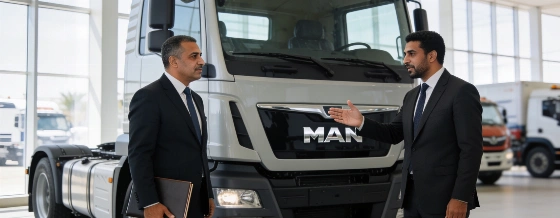
Germany's MAN Truck & Bus has named Libya Motors Company as its exclusive distributor in Libya, moving away from state partnerships to deliver premium vehicles and support to the country's commercial transport sector.
Germany's MAN Truck & Bus has changed its approach in Libya, leaving behind its earlier state-linked strategy in favor of working with a private partner. On 17 September 2026, MAN named Libya Motors Company as its only authorized importer in the country. The announcement was made during the IAA Transportation 2026 event in Hannover, where MAN presented its full range of commercial vehicles under the theme "Driving.People.Partner" and emphasized efficiency, availability, and safety in new markets. (official press kit).
The agreement was signed at the Hannover Exhibition, with leaders from both companies committing to bring MAN's trucks and buses, expanded service networks, and business solutions to Libyan customers. MAN and Libya Motors say the partnership will combine MAN's engineering with Libya Motors' local reach and aftersales support. According to Tunis Afrique Presse (TAP), more automotive companies in North Africa are turning to private sector distribution, following a regional trend toward liberalizing and updating logistics infrastructure.
State sector sidelined after failed assembly venture
This shift follows years of stalled talks between MAN and Libya's state-owned Libyan National Trailers Company. In February 2018, both sides discussed restarting the Tajoura truck and trailer assembly plant, with plans for feasibility studies, joint ventures, and possible exports to Africa. The agreement also included training Libyan staff. Despite these plans, the partnership never moved forward, and later meetings produced no results. The Maghreb Arab Press (MAP) has reported similar problems with other state-led industrial projects in the region, often pointing to bureaucracy and infrastructure delays.
By choosing a private distributor, MAN is distancing itself from the state sector, which has struggled to deliver on industrial projects. Libya Motors Company has a long history as Volkswagen's partner in Libya, making it a practical choice for MAN's renewed efforts. At IAA Transportation 2026, MAN also displayed vehicles ranging from 3.5 to 250 tonnes, showing its readiness to serve a wide range of fleet needs in North Africa (IAA press day).
Market implications and regional context
For Libya's commercial transport sector, MAN's vehicles and support services-now available through a private distributor-could change the competitive landscape. Expanded service networks and tailored business solutions are expected to set the company apart, especially as Libya works to modernize its logistics and mobility infrastructure. The move also highlights the growing role of private companies in areas where state-led projects have struggled. The United Nations Economic Commission for Africa (UNECA) notes that private sector involvement is increasingly important for infrastructure and economic diversification in the Maghreb.
This development fits a wider pattern of international companies adjusting their approach in Libya. For example, Libya's National Oil Corporation has sought foreign technology partners to modernize the energy sector (reported earlier). Still, ongoing power shortages and operational challenges, as reported by Reuters, continue to affect small businesses and the broader commercial sector, making reliable aftersales and technical support essential.
MAN's exclusive deal with Libya Motors Company is a clear choice for private sector flexibility over state-led projects. By working with an established private partner, MAN is betting on where real operational capacity and market access now exist in Libya. For other international manufacturers looking at North Africa, this move suggests that private alliances are becoming the most effective way to gain a foothold in the Libyan market.