Ten Kurdish migrants from Iraq are being held by armed groups in Libya, with families receiving ransom demands and no official confirmation of their whereabouts. The case exposes the limits of diplomatic intervention and the dangers facing migrants on the Central Mediterranean route.
Ten young Kurdish men from Iraq are being held by armed groups in Libya, with their families receiving ransom demands and no clear information about where they are or whether they are safe. The captives, all from Sulaimani province, have been told by their captors to pay $4,000 each for their release. The families have no way to verify the men's location or condition. According to the Libyan Ministry of Interior, the spread of armed groups outside government control in western Libya has made it nearly impossible to guarantee migrant safety. The African Union's Peace and Security Council has raised similar concerns in recent statements.
Libyan security officials told the Iraqi embassy that no Iraqi nationals are in official prisons, according to Muthanna Amin, a Kurdish member of Iraq's parliament foreign relations committee. Instead, the embassy was told that these detention sites are run by armed groups, leaving diplomats unable to intervene. Iraqi diplomats are required to work through official government channels and cannot negotiate directly with non-state actors, in line with the rules set by the Arab Maghreb Union's foreign ministries.
Smuggling networks and ransom schemes
The ten men, aged 18 to 25, left the Kurdistan Region 45 days ago, hoping to reach Europe by crossing the Mediterranean from Libya. Their families say they had already paid smugglers for the journey, but after arriving in Libya, the men were handed over to armed groups who demanded more money. The captives are thought to be held in informal sites such as Rahba, Bir al-Ghanam, and Hufra. Only one of the men has managed to confirm, during a brief call, that he is in Bir al-Ghanam. The Tunis Afrique Presse (TAP) agency has reported a rise in similar cases involving migrants from sub-Saharan and North African countries, pointing to a wider regional problem.
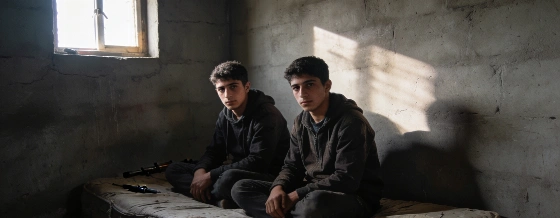
Just days ago, 33 Kurdish migrants detained in Libya were returned to the Kurdistan Region, but the risks for those still trying to cross the Central Mediterranean remain high. A video circulating online shows the ten men in captivity, with an Arabic-speaking narrator identifying them as Kurds. The families are left in the dark, as control over detention sites shifts between different armed groups. The Libyan Ministry of Interior says efforts to break up smuggling networks are hampered by political divisions and a lack of resources.
Diplomatic paralysis and regional consequences
With the Iraqi embassy unable to negotiate with armed groups, there is little hope for a quick resolution. Osman Mustafa, who leads the local migration and crisis response directorate, said officials are working with international agencies and Iraq's interior ministry, but the lack of state control in Libya leaves them with few options. Amin also mentioned six other young men from Sulaimani's Ranya and Pshdar who disappeared in Libya over three months ago, believed to have drowned after their boat sank in the Mediterranean. The Algerian Press Service (APS) has reported similar diplomatic problems for Maghreb states whose citizens fall victim to trafficking or armed groups abroad.
The situation highlights how vulnerable migrants are in Libya, where government authority is weak and armed groups operate freely. As previously reported, Libya's divided political system continues to undermine security and state capacity, affecting both local residents and migrants trying to reach Europe.
Since 2015, more than 500 migrants have been repatriated from Libya to the Kurdistan Region, according to the Directorate of Migration, Displaced, and Crisis Response in the Raparin administration. Still, many young people continue to risk the journey, driven by unemployment and economic hardship at home, and the hope of reaching Europe. The UN Economic Commission for Africa (UNECA) has warned that without coordinated action, the Central Mediterranean will remain one of the world's most dangerous migration routes.
This standoff shows the limits of diplomacy in a place where armed groups hold real power and state institutions are sidelined. For families, the reality is ransom demands and uncertainty, far from any official protection. Until state authority is restored and smuggling networks are dismantled, the Central Mediterranean will remain a dangerous path for migrants.