
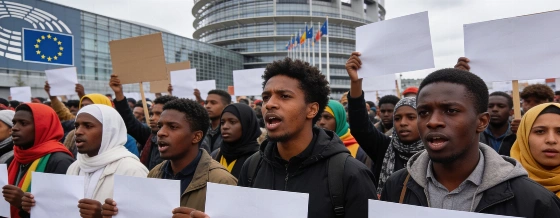
Hundreds gathered outside the European Parliament, demanding the EU intervene on behalf of Eritrean refugees detained in Libya. The protest highlighted the human cost of EU-Libya migration cooperation and renewed calls for Brussels to uphold basic rights.
Up to 1,000 people gathered outside the European Parliament in Brussels on 12 September, calling for urgent EU action to help Eritrean refugees held in Libyan detention centers. The demonstration directly criticized the EU's ongoing cooperation with the Libyan coast guard and demanded the release of those detained in places like Benghazi and Tajoura. Regional news agencies, including Tunis Afrique Presse (TAP) and the Algerian Press Service (APS), have also raised concerns about the humanitarian impact of migration management in North Africa.
Simon Rezene of De Eritrese Gemeenschap spoke for many in the crowd, saying the protest was not about open borders but about insisting that EU migration policies respect basic rights. This view is shared by civil society groups across the Maghreb, who have repeatedly asked the EU to rethink externalization strategies that put international protection standards at risk, as noted by the UN Economic Commission for Africa (UNECA).
EU migration policy faces criticism
The protest took place as European Commission President Ursula von der Leyen delivered her annual State of the European Union address. She pointed to a 55% drop in illegal border crossings over two years and announced a new European Emergency Response Framework for sudden migration surges. Von der Leyen also called for a stronger Frontex, the EU's border agency, and a "common European response" on migration and security. These steps confirm the EU's focus on tighter border management, as reported by the European Commission and Reuters. But activists and regional analysts, including those cited by Morocco's MAP news agency, warn that these measures risk putting the rights of vulnerable migrants behind security priorities.
Demands for safer migration routes and an end to the EU's reliance on Libyan enforcement have grown as reports of abuse and indefinite detention in Libya continue. According to AFP, Eritrean refugees in Libya have described beatings, sexual violence, extortion, and killings in detention centers. Many fled Eritrea's dictatorship and indefinite military service-conditions the United Nations has previously compared to slavery. The Brussels protest is the latest in a series of actions challenging the EU's practice of shifting migration controls to North African partners.
Regional instability deepens the crisis
Libya remains a key transit and detention point for migrants trying to reach Europe. The situation of Eritrean refugees in Libyan centers is closely tied to wider regional instability. In 2026, the International Organization for Migration (IOM) reported that sea arrivals to Europe had dropped by more than a third since the start of the year, but the journey has become more dangerous, increasing scrutiny of EU and Maghreb border policies. The recent release of 64 vulnerable people from the Ain Zara detention center in Tripoli, with help from the UNHCR, shows that international intervention in Libya's migration crisis is ongoing, as covered by Ahram Online.
These overlapping crises show how fragile migration routes through North Africa and the Sahel have become. As reported earlier, Libya's internal instability and resource shortages affect both migrants and local communities. Statements from the Libyan Ministry of Foreign Affairs and recent African Union meetings have also stressed the need for coordinated regional responses to address both humanitarian and security issues around migration.
Policy gridlock and the cost of externalization
Despite growing evidence of harm, the EU's migration strategy still relies on deals with transit countries like Libya. The Brussels protest shows that civil society is not willing to accept the human cost of these arrangements. The Europe External Programme with Africa (EEPA), which tracks migration and refugee flows in the region, continues to report on abuses and push for rights-based approaches. Regional news agencies, including APS and MAP, have covered the economic and diplomatic fallout of these migration agreements, noting that Maghreb states face pressure to balance EU cooperation with their own stability.
As the EU focuses on border security and emergency frameworks, the gap between policy statements and the reality for refugees in North Africa is growing. The current approach risks creating a system where basic rights are sacrificed for migration control. For Brussels, the message from the protest is clear: the credibility of EU migration policy now depends on whether it is willing to address the consequences of its external partnerships and put human rights at the center of its response.