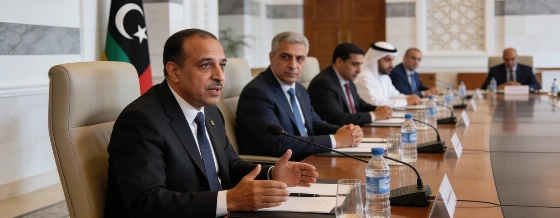
Libya's Ministry of Oil and Gas will bring together energy sector institutions in Tripoli on 24 September for a national conference focused on just and sustainable energy transition, aiming to chart a path for the country's energy future.
Libya's Ministry of Oil and Gas has announced a national conference on 24 September in Tripoli, bringing together major players from the country's energy sector. The event aims to open direct discussions on how Libya can move toward a more sustainable and efficient energy system while protecting its economic interests. This follows recent meetings, including a 16 September session between the Renewable Energy Authority of Libya (REAoL) and the Libyan British Business Council, where joint investment and cooperation were discussed. Libya has also been engaging with international and regional partners, such as the Arab Maghreb Union and the African Union Commission.
The Ministry's announcement comes as Libya looks to align its energy strategy with global trends, but without losing sight of the importance of oil and gas revenues. The conference will gather a range of institutions involved in the energy sector and the transition process, aiming to encourage cooperation and share expertise. Earlier this month, a national dialogue on shifting the extractive energy sector toward sustainable systems took place in Tripoli, organized by the UN Economic and Social Commission for Western Asia (ESCWA) and REAoL. That meeting focused on the 2023-2035 strategy, renewables, energy efficiency, and transition minerals, according to Miragenews.
Focus on sustainable transition and national priorities
The main challenge for Libya is how to balance its established oil and gas sector with the need to modernize and diversify. The Ministry says the conference agenda will focus on opportunities for a fair and sustainable transition, aiming to keep up with international developments while staying grounded in Libya's economic situation. According to the Algerian Press Service (APS), similar debates on energy diversification and renewables are underway across the Maghreb, with Algeria and Tunisia also working on national energy transition strategies in coordination with the African Union and the United Nations Economic Commission for Africa (UNECA).
Participants are expected to discuss practical ways to support Libya's transition, with a focus on sharing knowledge and building institutional capacity. The Ministry's approach follows earlier efforts to modernize the sector, including seeking international technology partnerships, as reported by Maghreb Insider. Libya's Minister of Oil and Gas, Khalifa Rajab Abdusadyk, recently told an international forum in Bangkok that the country aims to raise natural gas production to 4 billion cubic feet per day within 3-5 years, using both free and associated gas reserves. This goal matches statements from the Libyan National Oil Corporation and is being followed by regional agencies such as Tunis Afrique Presse (TAP) and the Moroccan MAP news agency.
Strategic implications for Libya's energy sector
The conference is intended as a forum for discussion, not for making binding decisions, but its timing and scope show that Libya's leadership sees the energy transition as an issue that needs attention. The Ministry's emphasis on a "just and sustainable" transition reflects the political sensitivity around any reforms that could affect national revenues or jobs in oil and gas. As of mid-September, Libya's oil production is steady at about 1.4 million barrels per day, despite recent protests and temporary shutdowns at some fields, according to Reuters. Oil remains central to the national budget.
Libya's economic stability is still closely tied to hydrocarbons, even as the global shift to cleaner energy speeds up. By holding this conference, the Ministry is trying to shape the national conversation and possibly influence future policy. Whether these talks lead to real changes or remain just discussion is yet to be seen. For now, opening the floor to input from across the sector is a step toward figuring out how Libya will handle the pressures of global energy transition while protecting its own interests, in line with regional practices and frameworks promoted by the African Union and UNECA.