
Libya's National Development Agency and Man-Made River Authority have brought the Qardabiya-Sadada section of the Man-Made River system back online after more than a decade of inactivity, aiming to reinforce water security and infrastructure resilience.
Water is running again through the Qardabiya-Sadada section of Libya's Man-Made River, ending a 13-year shutdown that left a key part of the country's water network unused. The National Development Agency (NDA) and the Man-Made River Authority marked the restart with a ceremony in Sirte. The Man-Made River, described by Reuters as a vast network of pipelines moving groundwater from the Sahara to the coast, remains central to Libya's water supply and serves millions in both cities and rural areas according to recent coverage.
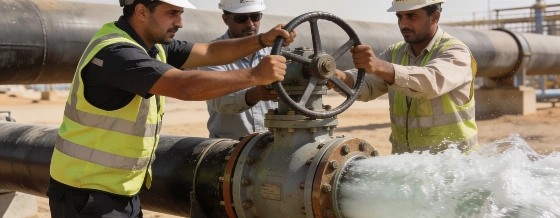
The reactivation followed nearly a year of repairs. More than 250 valves were sourced and installed to replace missing or damaged parts. The NDA oversaw the work, which included refilling and testing the pipeline to make sure it was ready for regular use. The project finished as regional efforts to update water infrastructure continue, with Tunis Afrique Presse (TAP) reporting on similar projects in Tunisia and the Maghreb.
System integration and operational flexibility
During the ceremony, the first-phase water inlet valve was opened, physically linking it with the second phase of the Man-Made River. This connection gives the system more flexibility to manage water supply during maintenance or emergencies and helps strengthen Libya's water distribution network. The system's vulnerability was clear in September 2026, when a nationwide blackout by the General Electricity Company of Libya (GECOL) cut off water from the Man-Made River, disrupting daily life and showing how much the network depends on stable power, as reported by Reuters and independent market sources.
The NDA called the reactivation a practical step toward protecting water security and infrastructure. The agency described the project as part of a broader push for construction, development, and public service, pointing to the need for reliable water access in a country where infrastructure has often suffered from instability. The African Union's North Africa Regional Office has repeatedly pointed out the need for resilient water management across the region, using Libya's experience as an example of both risk and recovery.
Regional water security and infrastructure challenges
Libya's renewed attention to water infrastructure comes as water security becomes a bigger concern across North Africa. The Qardabiya-Sadada section's return to service stands out compared to other regional water systems that have faced their own problems, as reported earlier in Mauritania. Restoring and connecting such a large-scale water project shows both technical ability and the political will to address major infrastructure gaps, even during national uncertainty. Algeria's APS news agency has also noted the importance of cross-border cooperation and investment in water security, especially as climate pressures grow across the Maghreb.
Bringing the Qardabiya-Sadada section back online is a concrete achievement for Libya's water sector. The NDA's work in coordinating the repairs and restart of this water link sets a reference point for future infrastructure recovery. For now, it is a rare but real success, and one that will be watched by those following Libya's efforts to rebuild and modernize its core systems.