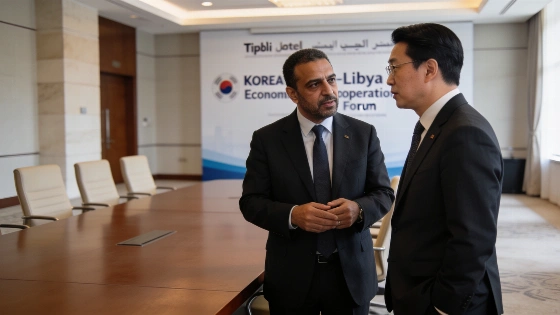
Libyan institutions and Korean companies are due to meet in Tripoli on September 27 and 28. The forum will pair bilateral meetings with talks on investment and joint projects.
A reception for the Republic of Korea's National Day is scheduled for the evening of September 27 in Tripoli.
The two-day Korea-Libya Economic Cooperation Forum 2026 will bring Libyan development priorities together with Korean industrial expertise. Its practical goal is to identify projects and follow-up opportunities, not just exchange views. The main sessions and bilateral meetings are set for September 28.
The forum comes as South Korea seeks closer economic ties with Africa. Regional coverage reported that the African Development Bank (AfDB) and the Export-Import Bank of Korea (KEXIM) signed a new agreement in Seoul on September 9, 2026. That wider financing and cooperation context may inform talks on moving project ideas toward implementation. No forum-specific financing commitments have been announced.
The Embassy of the Republic of Korea in Libya, Libya's Ministry of Foreign Affairs and International Cooperation, and the General Union of Chambers of Commerce, Industry, and Agriculture in Libya are organizing the forum. The Libyan-Korean Chamber of Commerce and Industry will also take part. Libya is separately developing a framework to coordinate external assistance, as described in an aid coordination plan. This forum has a different focus: trade, investment, and technical partnerships with Korean counterparts.
The opening session, "Renewing the Korea-Libya Partnership in a Changing World," is set to include Cho Woo-suk, Chargé d'affaires at the Korean Embassy in Libya; Suhail Abu Shiha, Libya's Minister of Economy and Trade; Mohamed Raied, Chairman of the General Union of Chambers of Commerce, Industry, and Agriculture; Yoon Young-gi, Deputy Director-General for African and Middle Eastern Affairs at South Korea's Ministry of Foreign Affairs; and Husni Bey, Chairman of the HB Group.
Government officials, business representatives, and a major private-sector group will share the discussion. Libya's Ministry of Foreign Affairs and International Cooperation and its Ministry of Economy and Trade are both involved. That puts diplomacy and commercial policy in the same room.
A second session, "From Innovation to Partnership," will look at how Korean capabilities could match Libyan priorities. KOICA, the Libyan-Korean Chamber of Commerce and Industry, and representatives from LG and Samsung are among those taking part.
Ashraf Al-Thalthi, founder and Chairman of the Libyan-Korean Chamber of Commerce and Industry (LKCCI), said the forum could give the two business communities a chance to engage directly and identify viable opportunities. Bilateral meetings with companies and institutions are scheduled for the afternoon. Participants will discuss priority projects, practical needs, potential tenders, joint ventures, technical cooperation, and partnership arrangements.
South Korea is not the only country Libya is courting. The Libyan News Agency reported that a separate French-Libyan economic forum brought 17 French companies into discussions with Libyan counterparts. The parallel effort points to Libya's wider search for overseas investors and sector-specific partners. Meetings still need to produce defined projects and follow-up.
The program opens with a reception for the Republic of Korea's National Day and a networking dinner on Sunday evening. Plenary sessions, a working lunch, and bilateral meetings will follow on Monday at a leading hotel in Tripoli. A Libyan News Agency report on the French-Libyan forum provides a recent comparison with Libya's other economic outreach efforts.
The measure is what comes next. The meetings will need to turn broad cooperation goals into identifiable projects and practical follow-up. The business sessions will show whether the Korea-Libya partnership can deliver something concrete.