
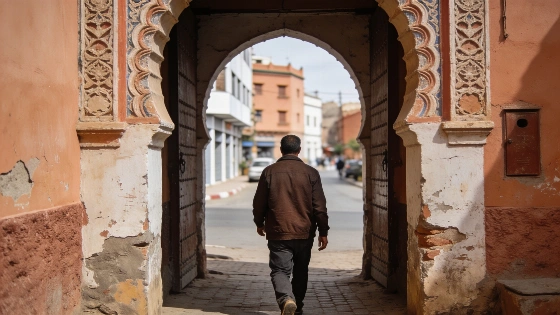
Morocco's past draws on Amazigh foundations and Arab-Islamic heritage. The challenge is to recover confidence in that layered identity while resisting new forms of external dependence.
Morocco became independent in 1956, but the end of the French and Spanish protectorates did not settle who could define the nation's past.
Ceuta and Melilla remained under Spanish administration. They were not included in the sovereignty transfers, and their status remains disputed between the two countries. That history informs Morocco's continuing decolonisation claims.
The question reaches beyond politics. Colonial power can shape how a society sees its language, memory and worth long after formal rule ends. Independence did not settle who gets to tell Morocco's story.
Morocco's foundations are profoundly Amazigh. Arab-Islamic heritage became another defining layer. The country's connections also reach across Africa, the Mediterranean, the Atlantic and the wider Islamic world. These identities are not rivals. Moroccan identity has built up over time rather than replacing one civilisation with another.
That layered history makes familiar binaries, such as East and West or tradition and modernity, useful but incomplete. They can expose power relations. They cannot explain every continuity that shapes Morocco.
The 2011 Constitution recognises Arabic and Amazigh as official languages. Organic Law No. 26-16, promulgated by Dahir No. 1-19-121 on 12 September 2019, set out the staged implementation of Amazigh's official status in education and priority areas of public life, as recorded in the official legal bulletin. The change was formal.
The constitutional reform followed the February 20 protest movement and took shape amid the wider Arab Spring. It recognised Morocco's cultural plurality and strengthened the formal roles of parliament and the head of government. The monarchy remained central to the political system. The reform gave debates over national identity an important institutional context, but it did not resolve them.
Frantz Fanon, Edward Said, Homi K. Bhabha and Gayatri Chakravorty Spivak examine different parts of colonial power. Their work addresses internalised inferiority, knowledge and representation, unstable cultural identities, and barriers facing people who have historically been silenced. Decolonisation is more than a change of government or borders.
But a framework built to challenge colonial categories can become too broad if it treats different societies as interchangeable. Said's analysis of Orientalism examined how Europe constructed an imagined "Orient" as its opposite. It did not describe one coherent civilisation. Applying that label to Morocco as if it explained the country risks repeating the very flattening the critique opposes.
Morocco also seeks to define itself through wider engagement across Africa, Europe, the Atlantic and the Middle East. A border strategy with Mauritania offers one example of outward-facing policy. It cannot, by itself, resolve the deeper question of historical self-definition.
The economic stakes include transport links, port logistics, renewable energy and value chains around major exports. The Morocco-Algeria land border remains closed. That is a structural obstacle to deeper Maghreb trade and regional integration, a concern that belongs within the wider regional perspective of the UN Economic Commission for Africa (UNECA).
Regional economic ties show the gap between diplomatic ambition and practical connections. Morocco's engagement with West African markets and its Atlantic and Mediterranean routes offer avenues for trade. Cooperation across the Maghreb remains limited.
Morocco's state news agency, Maghreb Arabe Presse, offers a view of how public institutions present the country's domestic and external priorities. Those announcements should be read alongside the wider regional constraints on commerce and movement. The pressure is real.
Neocolonial influence works less through occupation than through financial dependence, unequal geopolitical relationships, cultural influence, technological gaps and outside standards for development. These pressures make self-definition more than a cultural question. They test whether a country can engage with the world without treating outside approval as the measure of its worth.
The central insight is psychological. Domination can leave a society wary of outsiders and of its own memory and judgement. For Morocco, the answer is neither isolation nor nationalism built on exclusion. It is confidence grounded in historical knowledge, with room for Amazigh, Arab-Islamic, African, Mediterranean and Atlantic identities.
Morocco's postcolonial task is not to choose one inheritance or reject global engagement. It is to regain the confidence to define progress on its own terms and recognise how external power still operates. That is a demanding measure of decolonisation. It treats history as a resource for the future, not a prison.