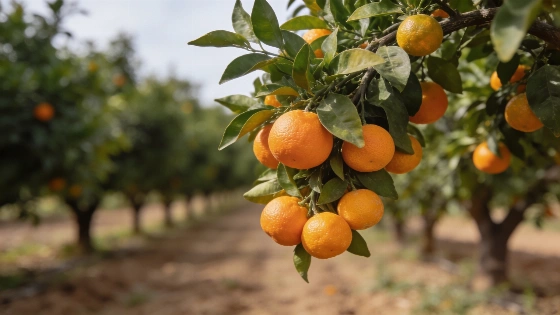
Morocco expects citrus production to fall to 1.8 million tons in 2026-27 after heat and flooding damaged yields, while exports are forecast at nearly 540,000 tons as larger fruit offsets some of the volume loss.
Summer temperatures reached 46°C, damaging flowers and young fruit, while flooding in the Gharb region added pressure on orchards. Alternate bearing, the natural cycle in which a heavy crop is followed by a lighter one, also affected yields.
Morocco's citrus harvest is forecast to reach approximately 1.8 million tons in the 2026-2027 season, down 20 per cent from 2.2 million tons last season, according to Kacem Bennani Smires, president of Maroc Citrus, as reported by Medias 24.
Heat and flooding weigh on the crop
Small citrus fruit output is expected to decrease by 15 per cent. Clementines are forecast to fall 20 per cent, while Nadorcott production is expected to decline 6 per cent.
Growers face rising input costs and labor shortages. Competition from Egypt and Turkey adds pressure. Morocco has lost nearly 34,000 hectares of citrus orchards over the past decade, with repeated drought and inadequate irrigation water cited as drivers of orchard removals, according to Le Desk's sector report.
The same report puts Morocco's historical average citrus production at about 2.5 million tons annually, with peaks above 2.6 million tons in the 2018-2019 and 2021-2022 seasons. It also describes a longer-term decline in export volume: around 550,000 tons annually compared with roughly 600,000 tons before 2020. Export receipts, however, rose from 3.8 billion dirhams to more than 5 billion dirhams in 2025.
Exports rely on larger fruit
Despite the smaller crop, exports are forecast at nearly 540,000 tons, a 7 per cent decline. Lower fruit loads and improved water availability are expected to produce larger fruit, increasing the share suitable for export.
The European Union takes nearly 38 per cent of Moroccan citrus exports. Russia accounts for 17 per cent. Canada and the U.S. each take 15 per cent, while Africa receives between 12 and 14 per cent. For the 2025-2026 campaign, the U.S. agricultural service in Rabat projected total citrus exports of about 645,000 tons, including 550,000 tons of mandarins and clementines. Morocco's wider export infrastructure has also featured in reporting on Tanger Med expansion plans.
Future recovery of the country's citrus orchards depends on the development of irrigation infrastructure.