

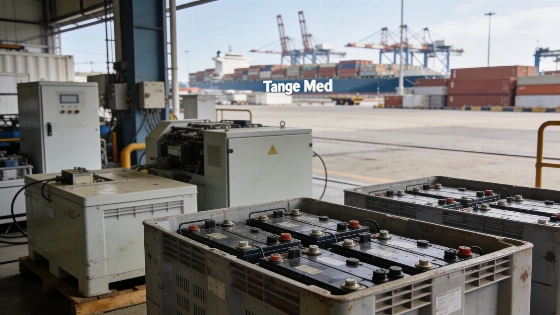
Chinese firms are building battery and component capacity in Morocco. Existing infrastructure and access to Tanger Med could support future vehicle assembly and duty-free entry to Europe if origin rules are met.
Morocco could give Chinese automakers a way to reduce EU tariffs, but the route depends on building vehicle assembly and meeting rules of origin. Chinese companies are already investing in battery production and components, creating an industrial base that could make the next step more feasible.
The stakes are large. In October 2024, the EU imposed five-year countervailing duties on battery-electric vehicles manufactured in China. Manufacturer-specific rates range from 7.8 percent to 35.3 percent under Regulation (EU) 2024/2754, on top of the standard 10 percent passenger-car import tariff. The highest combined rate is so 45.3 percent. The measure covers battery-electric vehicles, not hybrids or plug-in hybrids, which remain subject to the ordinary 10 percent tariff. Vehicles qualifying as Moroccan in origin can enter under the EU-Morocco trade arrangement without the China-specific countervailing duties. For an assembled vehicle, foreign parts must account for less than 45 percent of its ex-works price.
If Chinese firms meet those conditions, the combined tariff effect, potentially as high as 45.3 percent, could fall to zero. That remains a conditional pathway, not an established export practice: Chinese automakers are not yet building assembly plants in Morocco. The EU's preferential trade rules determine origin based on the product and its production, not simply the nationality of its brand or parent company. Domestic free-zone incentives in Morocco do not, by themselves, confer EU preferential origin.
Infrastructure is laying the groundwork
China's position in Morocco has grown alongside a broader diplomatic and investment relationship. Morocco joined a strategic partnership with China in 2016 and entered the Belt and Road Initiative the following year. By March, China's committed investment in the country had exceeded $10 billion, concentrated mainly in energy and electric vehicles.
State-owned enterprises helped shape the field into which private investors are moving. Their work has included road and bridge projects. Smart-city projects have also featured. In Khouribga, a chemical processing unit is relevant to battery production because the area holds one of the world's largest phosphate reserves.
Tanger Tech City sits less than 30 miles from Tanger Med, Africa's largest container port. The industrial zone offers no-fee business registration and tax-free dividends. Private companies including BTR New Material Group and Sentury Tire have established production bases there or announced plans to do so. Guizhou Tyre has also established a production base or announced plans to do so.
Chinese firms have announced about $6 billion in investment in Moroccan battery and electric-vehicle component plants. Other large investments include Gotion's $1.3 billion battery factory and a $2 billion joint-venture battery materials factory involving CNGR Advanced Material and Moroccan private-equity firm Al Mada. These are battery and materials projects, not vehicle assembly plants. Chinese investment in cathode materials and battery production sits alongside capacity expansions by European automakers Stellantis and Renault. Chinese firms are also benefiting from credit and cross-border settlement support under a 2024 directive to Chinese financial institutions.
The strategy has parallels in other efforts to build local business channels; Canon's Morocco channel strategy paired new imaging products with local partner planning in Casablanca, though it concerns a different industry.
Rabat's interests shape the partnership
Morocco wants to expand domestic manufacturing and present itself as an industrial hub for Africa. Chinese investment is expected to create jobs in a country where unemployment has remained close to or above 10 percent for much of the past decade. Youth unemployment in cities stands at 47 percent. Moroccan officials say Gotion's factory alone will create 17,000 local jobs, including 2,300 high-skilled positions.
Beijing's diplomatic stance on Western Sahara has also shifted in Rabat's favor. China had generally supported U.N. Security Council resolutions extending the peacekeeping mission and affirming the Sahrawi people's right to self-determination. In 2024, its foreign ministry said China was ready to support Morocco on issues concerning each side's basic interests. In a later vote, Beijing abstained on a resolution endorsing Rabat's proposal for autonomy under Moroccan sovereignty.
Assembly remains the decisive test
The planned industrial environment is still short of vehicle production. A BYD assembly plant project, stalled since 2017 over budget issues and limited local charging infrastructure, was recently shelved, information from a company executive. Battery and tire production, along with other components, can reduce reliance on shipments from China and lower costs for assembly plants in Europe and Africa, but it does not itself satisfy the conditions for Moroccan origin.
China is using related models elsewhere. In Thailand, investment in the Eastern Economic Corridor has helped create a setting for Chinese EV and related businesses, supported by tax incentives and access to Southeast Asian markets. In the United Arab Emirates, Jiangsu Provincial Overseas Cooperation and Investment Company Limited partnered with Abu Dhabi Ports in 2017 to develop an industrial zone at Khalifa Port. By 2025, more than 40 Chinese companies had committed over $700 million to the park, focused on EVs and renewable energy.
For Morocco, the commercial test is whether investment in upstream production can be followed by vehicle assembly that meets EU origin rules. Until then, tariff-free access remains a possibility tied to the requirement that foreign parts make up less than 45 percent of a vehicle's ex-works price.







