
A report says Morocco plans to extend AI-assisted prenatal ultrasound from a 10-centre pilot to 50 rural clinics in Béni Mellal-Khénifra. Ministry of Health material confirms broader health-centre development and a telemedicine policy, but does not verify the AI programme's expansion or pilot figures.
In parts of Béni Mellal-Khénifra, pregnant women have reportedly travelled an average of 90 kilometres for an ultrasound. A report on Morocco's AI-assisted prenatal screening programme says it will add the service at 40 rural health centres, bringing the regional total to 50. The Ministry of Health and Social Protection's public materials do not confirm the expansion or the reported pilot results.
The reported plan would bring screening closer to patients who may otherwise receive prenatal care from midwives and general practitioners without a gynecologist or radiologist on site. That goal fits the ministry's broader digital-health policy. Its earlier telemedicine material describes extending specialist care to remote rural, mountainous and semi-urban areas, while reducing patients' physical and financial burden. The ministry's telemedicine policy offers context, but does not confirm that AI ultrasound is part of the initiative.
Ministry updates also describe new or strengthened health-centre services in Béni Mellal-Khénifra. One update covers activity involving 21 centres; a separate project involves 15 centres and the local-level hospital in Demnate. Another communiqué concerns 27 urban and rural centres across Béni Mellal-Khénifra and Fès-Meknès. These projects show continued investment in primary care, but the available material does not connect them to AI prenatal scans or give programme costs or clinical outcomes.
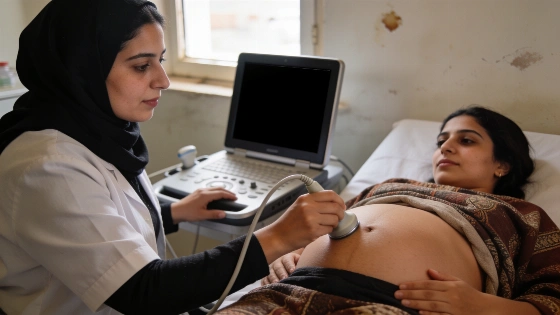
The account of the pilot says the system pairs a portable ultrasound probe with a tablet and guides healthcare workers through seven standardized scans. AI analyzes images in real time. It identifies structures such as the fetal head, spine and heart, and assesses the placenta and amniotic fluid. The system then produces a digital report, which, according to the account, a physician must review and approve.
The report gives pilot figures for 10 centres: 416 pregnant women monitored, 27 midwives trained and more than 16,500 fetal structures analyzed. It says examinations now take between half and a third of the time previously required, and trained midwives use the equipment daily. The ministry's accessible releases do not independently corroborate these figures. The claimed benefits include helping staff sort routine pregnancies from those that need specialist care, which could reduce referrals, transport costs and pressure on hospitals.
The programme is also described as a way to identify and refer patients with complications such as preeclampsia, abnormal amniotic-fluid levels and irregular fetal heart rhythms. Its stated aims include earlier detection of some serious fetal abnormalities, including those identifiable in the first trimester, and storing prenatal records in a centralized patient file instead of on paper. These are reported aims, not proof of diagnostic accuracy or better outcomes. The account says a physician must approve the report, and reliable clinical follow-up remains necessary.
An earlier report on Algeria described oncology nurses helping identify treatment complications and coordinate care, as an earlier report noted. That comparison concerns access to care, not proof that the two countries use equivalent technology. Morocco's documented health-centre and telemedicine initiatives provide context for efforts to bring services closer to rural communities, but they do not verify this specific AI screening rollout.
The reported expansion still needs confirmation on its scale, cost and clinical results. The programme's account says physicians review and approve the scans, but the ministry's available public material does not verify the expansion from 10 centres to 50.