

Russia's October 30 veto left the 35-year U.N. mission in Western Sahara winding down. Morocco's port plans now sit alongside expanding U.S. defense ties and Chinese industrial investment.
On October 30, 2026, Russia vetoed a U.S.-drafted Security Council resolution that would have preserved a reformed U.N. peacekeeping force in Western Sahara. The 35-year mission is winding down. The U.S. draft, document S/2026/868, received 11 votes in favor. China abstained, as did Pakistan and Somalia, but Russia's veto blocked its adoption. It proposed a one-year renewal through October 31, 2027, and a new name: the U.N. Mission in Western Sahara, or MINUSO, as recorded in the Security Council meeting record.
Many countries opposed a Russian counterproposal. Moscow sought to extend MINURSO for a year under its existing name and mandate, but the text did not secure the nine affirmative votes required for adoption. Neither draft passed before the deadline. MINURSO's mandate expired at midnight on October 31, ending the mission's operations. The Council vote followed earlier disputes over the mission's mandate, covered in an earlier account. The change removes a Cold War-era mission while leaving Western Sahara's status unresolved; the United Nations still lists the territory as Non-Self-Governing. The U.N. said it would continue diplomatic work through Secretary-General António Guterres's Personal Envoy, Staffan de Mistura, and that it "stands ready" to support peace efforts, the United Nations reported.
Ports connect the Atlantic coast to the Sahel
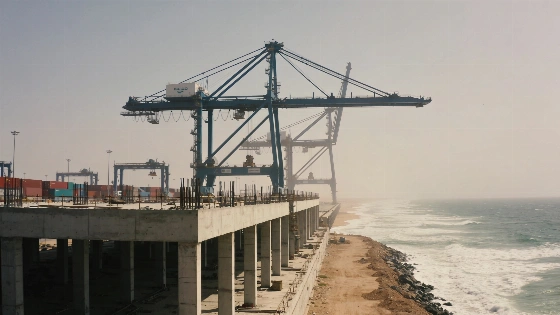
Morocco is developing a coastal network of ports and industrial zones, alongside energy infrastructure and trade corridors. The plan aims to link Europe and the Maghreb with landlocked Sahel states. This infrastructure is part of a broader effort to extend trade access southward.
On October 28, King Mohammed VI chaired a working session on Nador West Med and Tanger Med. Rabat announced construction would begin on Tanger Med 3. After planned expansions, the government says Tanger Med could handle up to 20 million containers.
Farther south, Morocco is building Dakhla Atlantic in Western Sahara. The port is planned to serve heavy industry and trade with landlocked Sahel states when it opens later this decade.
Investment and security ties overlap
Morocco's Atlantic African States Process, launched in 2022, covers maritime security and connectivity, as well as energy and the blue economy. At its seventh ministerial meeting in Cotonou in July 2026, Morocco served as co-chair. Rabat has offered Mali, Niger, Burkina Faso and Chad access to Atlantic infrastructure.
Defense cooperation with Washington is also expanding. On July 13, the Royal Moroccan Armed Forces and United States Africa Command signed a memorandum to establish an Africa Multidomain Training and Experimentation Center in Tan-Tan by 2030. In August, U.S. and Moroccan forces used the facility, still under development, for a live-fire demonstration of long-range precision-strike capabilities. Morocco hosted planning for African Lion 2027 in October. The exercise is expected to involve more than 45 countries.
European engagement is part of the picture. In January, the European Union and Morocco reaffirmed their strategic partnership and discussed the Atlantic African States initiative, alongside Sahel stability. NATO's special representative for the southern neighborhood visited Rabat in October to discuss terrorism and maritime security in the Sahel.
China is building a commercial presence around Tangier. Its Commerce Ministry describes Mohammed VI Tangier Tech City near Tanger Med as a bilateral industrial project. In January 2026, China's ambassador visited Tangier Tech and Tanger Med to promote supply-chain cooperation. A Chinese government report said the site had agreements with 42 companies by March. Of those, 34 were Chinese, with about $3.5 billion in planned investment.
Publicly accessible agreements point to industrial investment, with manufacturing and trade also in focus; they do not indicate a Chinese naval foothold. Morocco continues to base defense cooperation on the United States and maintain close ties with Europe. Washington's stake is to support the infrastructure network without allowing commercial dependence to become strategic leverage.
In October, Morocco named Maersk-APM, a Danish-led operator, concessionaire for the new container terminal at Tanger Med 3.







