

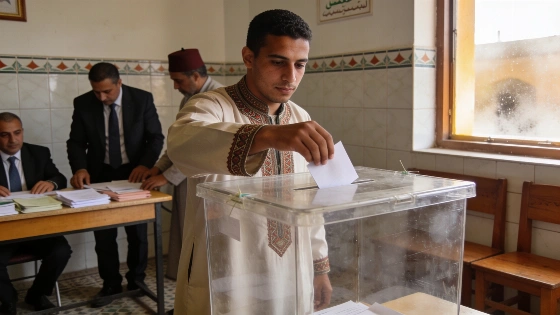
PAM secured 97 seats as turnout fell to 38.08%, down from 50.86% in 2021. Young candidates from peripheral territories are pressing for better services and accountability, with their influence dependent on oversight and delivery.
For residents far from decision-making centres, representation is tested by the public services they can actually reach. Morocco's 23 September election renewed Parliament, but the results expose a clear tension between formal representation and weak participation.
The Ministry of the Interior announced 38.08% turnout, down from 50.86% in 2021 and 42.27% in 2016. The Associated Press described the 2026 figure, rounded to 38%, as Morocco's lowest turnout since 2007. PAM won 97 seats in the 395-seat House of Representatives. The RNI took 66, Istiqlal 65 and the PJD 54. Interior Minister Abdelouafi Laftit announced the provisional results on 24 September. The results establish the political setting, but they do not show by themselves whether citizens trust the new Parliament.
Turnout sets the test for representation
Fourteen parties or groups won seats, information from the Inter-Parliamentary Union. The Ministry of the Interior's final results, announced on 23 October, matched the preliminary distribution. Alongside PAM, RNI, Istiqlal and the PJD, the largest seat totals went to the Popular Movement with 29 and the Socialist Union of Popular Forces with 26. The Party of Progress and Socialism won 19, while the Constitutional Union took 17. The Democratic and Social Movement and Left Alliance each won eight seats; four other groups received between one and two seats. That breadth of representation sits alongside a marked decline in participation.
Turnout also varied sharply by location. LeBrief reported participation of 21.26% in Moulay Rachid and 88.45% in Tarfaya, against a national rate of 38.08%. The figures do not establish a constitutional legitimacy crisis. They sharpen the question of whether parties can sustain public engagement beyond election day.
Abstention has no single meaning. It may reflect disillusionment or indifference. Practical barriers can also play a part, as can a belief that no party offers a credible choice. Abstention is not a vote under the law and confers no distinct parliamentary mandate. In an article published on 25 September in Le Monde Amazigh, Chtatou argued that non-participation should be treated as a political signal without assigning every abstainer the same motive.
Young candidates are trying to address some of the concerns behind that distance. Hajar Elkahlaoui's report, published on 22 September, connects the election environment to Generation Z mobilisations in Morocco during 2025, when education and healthcare were prominent concerns. Employment and government accountability also featured. Her report describes candidates seeking to carry those demands into electoral politics, while some young people remained doubtful that established parties could respond. These demands include better public services and employment, alongside fairer access to chance and greater accountability. An Associated Press report also described distrust among some young people linked to job prospects and gaps in public services. It noted a sense of inequality, along with the barriers younger candidates face.
The evidence supports a distinction between new voices entering politics and a change of Parliament itself. Reporting documents candidates seeking more direct and accountable politics; it does not establish that parliamentary practice has changed across the institution.
Peripheral demands are about access to chance
"Morocco's deep interior" describes a political and social condition rather than a single administrative zone. It includes rural and mountain communities, as well as oasis areas, smaller towns and peri-urban neighbourhoods where access to services, infrastructure or skilled work may be limited. Distance from Rabat or Casablanca matters, but so does the gap between rights promised and opportunities available in daily life.
That gap is not uniform. A rural community may struggle with school transport, while an urban neighbourhood faces poor access to healthcare or employment. The New Development Model, presented in 2021, identifies territorial convergence and human capital as priorities, alongside institutional trust (CSMD, 2021). The challenge is turning those priorities into services that work and opportunities distributed in response to local needs.
When young candidates ask about a functioning health centre or access to local jobs, they raise a broader question: how effectively does public policy turn resources into usable rights? Amartya Sen's account of development as an expansion of substantive freedoms offers one way to assess that question. A facility's existence matters less than whether people can use it to access education, healthcare or mobility (Sen, 1999).
Needs also vary between territories. Water constraints in south-eastern oases differ from those in agricultural areas of the Souss. The Rif and High Atlas have distinct local conditions. Fairness so requires national guarantees alongside policies adapted to geography and need; equal treatment does not always mean identical investment.
From campaign language to parliamentary scrutiny
Criticism of political jargon carries most weight when promises lack named responsibilities, deadlines or measurable results. Candidates who ask why a school lacks teachers or whether local residents can access jobs created by an investment are demanding answers that can be checked. That directness can make neglected problems harder to obscure.
It does not guarantee effective policy. Simple language can flatten complex problems or replace evidence with accusation. The relevant measure is whether representatives identify a problem, clarify who is responsible and advance proposals whose effects can be assessed. Available reporting documents that ambition among some candidates, not a wholesale change in the House's language.
Political representation also depends on who can win a nomination and run a campaign. Oubachir reported voter scepticism and resource barriers facing some young candidates. A candidate's age or place of origin does not automatically make them more capable or representative; the test lies in their conduct, commitments and results.
Parties remain impressive intermediaries. They organise candidates and combine different demands into programmes, but their role weakens when selection is opaque or local engagement fades outside election periods. Morocco's parliamentary renewal also unfolds alongside external engagement. A report on Morocco's regional partnerships covered trade and cooperation mechanisms with Senegal and DR Congo, a separate policy arena from domestic accountability.
Advanced regionalisation could bring public decisions closer to residents, yet transferred responsibilities need money, staff and administrative capacity. When several institutions share responsibility for a service, Parliament can question ministers and scrutinise budgets, helping clarify who is accountable. Local demands become more actionable when representatives document service gaps and follow up on public spending.
What would make the new voice consequential
The risk is symbolic inclusion: parties can showcase young candidates while leaving selection practices and decision-making unchanged. Local demands can also compete if they are not connected to national priorities and transparent funding. Representatives will need to keep contact with constituents after the campaign and report what they do with their mandates.
That makes measurable commitments and budget scrutiny basic to the political test. The New Development Model sets out broad priorities, while candidates have come forward in the election saying they want more concrete politics. The Article19.ma report outlines how some candidates aim to translate Generation Z mobilisation demands into electoral commitments. The election results became final on 23 October, when the Ministry of the Interior said the provincial and regional census commissions' tabulation exactly matched the provisional results. The official final results confirmed PAM's 97 seats and the distribution across the 395-member chamber.
The Ministry of the Interior reported turnout of 38.08%, compared with 50.86% in 2021 and 42.27% in 2016.







