

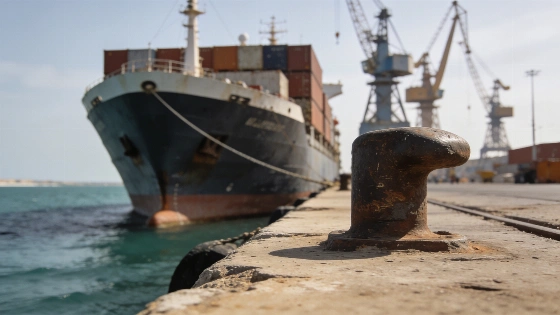
Morocco's National Ports Agency has secured a €100 million (about US$112 million) 13-year loan for its 2023-2030 programme, with funding directed toward port upgrades and a major southern-coast focus.
Moroccan ports handled 262.6 million tonnes of cargo in 2025, up 8.9% from 241.2 million tonnes a year earlier, according to the Ministry of Equipment and Water. Tanger Med recorded 10.3 million TEUs in container transhipment traffic, a 7.9% increase.
As volumes rose, the National Ports Agency signed a €100 million agreement with the French Development Agency (AFD) in Rabat on 3 November 2026, according to a joint declaration. The 13-year loan carries no Moroccan government guarantee, leaving the agency responsible for repayment. Maghreb Insider previously covered the southern ports financing.
Funding targets upgrades and southern ports
The loan supports the agency's 2023-2030 investment programme. It is built around port infrastructure, alongside renewable energy and desalination facilities. The programme also covers fishing-port modernization, as well as decarbonization and quay electrification.
The programme gives particular attention to Tan-Tan and Tarfaya. It also covers Laâyoune and Boujdour, along with Dakhla and Lamhiriz. Its stated aims include supporting economic development in surrounding areas and strengthening Morocco's position on the Atlantic coast.
The region also figures in Morocco's ambition to attract transit trade from Sahel economies such as Mali and Niger. That cargo currently moves through ports in Senegal and Côte d'Ivoire. Ghana also handles the traffic.
Agency carries repayment risk
Under the non-sovereign structure, the National Ports Agency, rather than the Moroccan treasury, must service the debt. It needs to generate enough revenue from port operations to meet repayments.
AFD and the agency began working together in 2012 with a €50 million loan. Their July 2020 agreement included another €100 million loan and an €800,000 grant for a programme exceeding €600 million. That earlier investment covered stronger port structures, protection against rising sea levels, energy efficiency and marine-pollution prevention.
Port construction is also advancing elsewhere. Morocco inaugurated the container terminal at Nador West Med, while APM Terminals received a concession to develop Tanger Med 3, planned with annual capacity of 4.5 million TEUs. The agency's wider trade ambitions also depend on stronger inland transport connections and facilities that attract shipping operators. The source identifies sustained capacity to capture regional cargo flows as another requirement.







