

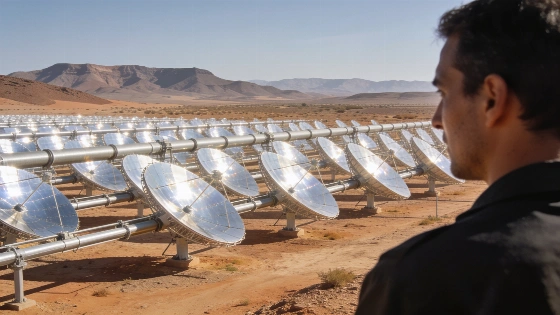
A geospatial study models 12.28 million metric tons of annual hydrogen output from a 10% build-out of high-potential land, with southern regions leading and water and grid constraints shaping deployment.
The model assumes a 10% build-out of land rated highly suitable for concentrated solar power. That would produce an estimated 231.51 gigawatts of capacity and about 630 terawatt-hours of electricity a year.
Researchers translate that output into a national estimate of 12.28 million metric tons of green hydrogen annually. This is modeled potential, not a forecast of production from projects already operating. Morocco's current hydrogen pipeline is smaller: the government's "Offre Maroc" framework has been associated with six projects, around $34 billion in investment, 6.5 gigawatts of electrolyzer capacity and potential output of about one million tonnes of hydrogen annually. Those figures describe projects in development, not operating capacity; budget-policy reporting said the projects remained at preliminary and front-end engineering stages, with no first-production date announced.
Southern regions dominate projected volume
Souss-Massa leads the regional estimates at 2.74 million metric tons a year, followed by Guelmim Oued Noun at 2.62 million. The study links their larger totals to extensive flat land and strong solar resources.
Central and northern areas score better on output per hectare and per gigawatt of installed capacity. Casablanca-Settat and Rabat-Salé-Kénitra could therefore suit earlier deployment, where land is more constrained and infrastructure is better developed.
The study estimates that very high-potential zones cover 7.87 million hectares, or 10.9% of Morocco's land. Some align with transport and power infrastructure that could support export routes toward Europe. The analysis does not establish the cost or feasibility of building those connections.
How the sites were assessed
The researchers used a two-stage geographic information system process across Morocco's twelve administrative regions. First, a fifteen-layer exclusion screen removed legally or environmentally restricted land, including areas around military installations, protected areas, urban extents and forest reserves. Setbacks included 500 metres from military zones and 13,000 metres from existing solar plants.
The remaining sites were ranked against nine criteria using the Analytic Hierarchy Process. Capacity factor received the greatest weight at 32.6%. Direct normal irradiance was weighted at 16.9%, while temperature received 15.3%. The researchers report a Consistency Ratio of 4.8%, below the 10% threshold used in the study.
Hydrogen calculations assume electrolyzer efficiency of 65% and a lower heating value of 33.33 kilowatt-hours per kilogram. The 12.28-million-ton estimate rests on those assumptions and the modeled electricity output.
Water and delivery remain constraints
Cooling, mirror cleaning and electrolysis would add to water demand in arid locations. The study says dry-cooling or hybrid systems could reduce use by 50% to 90%, with some efficiency penalties. It also proposes locating plants near Atlantic coastal desalination facilities as a possible supply measure. Environmental analysis published by The Conversation has also raised concerns about water availability and marine ecosystems in connection with large-scale green-hydrogen export plans in North Africa.
High-potential southern sites are distant from northern demand centres and European export terminals. The researchers identify dedicated high-voltage direct-current lines and hydrogen pipelines as possible ways to address transmission and transport bottlenecks. Morocco's hydrogen investment framework is also intended to develop renewable power, electrolysis and downstream products such as green ammonia. In March 2025, the state selected six projects backed by five investors across the three southern regions, with announced investment estimated at 319 billion dirhams, according to Le Desk. A Maghreb Insider report on project delays said Morocco's first green hydrogen output was not expected before 2031, even in an optimistic scenario.
The modeled build-out is large compared with Morocco's existing electricity system. At the end of June 2026, installed capacity stood at 12,364 megawatts, including 5,780 megawatts of renewables: 1,063 megawatts of solar, 2,597 megawatts of wind and 2,120 megawatts of hydropower. Renewable sources accounted for about 46.7% of installed capacity, La Relève reported. Morocco's stated objective is to exceed 52% renewable capacity by 2030. The 2026-2030 equipment plan provides for 18,088 megawatts of additional capacity, including 6,722 megawatts of solar; the Noor Atlas program, led by MASEN and ONEE, comprises six photovoltaic plants totaling 305 megawatts, with commissioning expected from 2027.
Green hydrogen also has an industrial role in Morocco. OCP is pursuing it to secure lower-carbon ammonia for phosphate fertilizers, with reported ambitions of one million tonnes of green ammonia annually by 2027 and three million tonnes by 2032. A planned development in Laayoune has been reported at roughly $4.5 billion, with more than two gigawatts of renewable capacity and a 900-megawatt electrolyzer system. It is designed to produce around 100,000 tonnes of hydrogen annually for about 560,000 tonnes of green ammonia.
The model covers only parabolic trough technology and applies the same 10% build-out fraction across suitable land. Its grid data comes from OpenStreetMap, which may have incomplete coverage in southern Morocco. The study does not calculate the levelized cost of hydrogen or pipeline costs, leaving those questions for future techno-economic work.







