Morocco wants AI to contribute 100 billion dirhams to GDP by 2030. The roadmap sets job and training targets, while Orange Maroc has announced three digital partnerships.
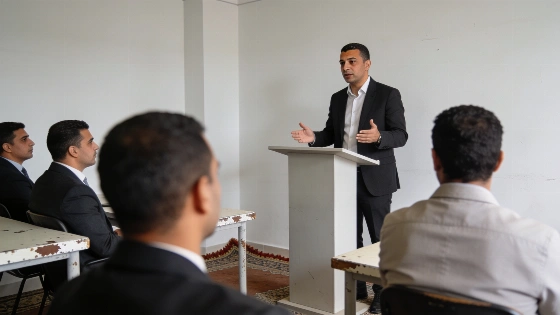
About 1,200 people attended the eighth AUSIM conference in Tangier. Executives and IT directors joined public decision-makers and experts to discuss Morocco's plans for artificial intelligence.
The government wants AI to contribute 100 billion dirhams to GDP by 2030. It also targets 50,000 jobs and training for 200,000 people. These are ambitions, not confirmed outcomes. The goals give the effort to move AI from experimentation into industrial use measurable economic and workforce targets.
The roadmap builds on Digital Morocco 2030, launched in 2024, and the 2025 EA Morocco plan. That plan focuses on AI regulation and governance. It also covers skills and development.
Under the government's AI Made in Morocco initiative, near-term priorities include sovereign computing resources for researchers and startups. The plan calls for a stronger legal and institutional framework. It also proposes AI models for Arabic and Darija, with Amazigh models included as well. Other priorities include large-scale workforce certification and the use of agentic AI systems in public services. These measures appear in the digital transition ministry's strategy. Their announcement does not mean the systems or infrastructure are already operational.
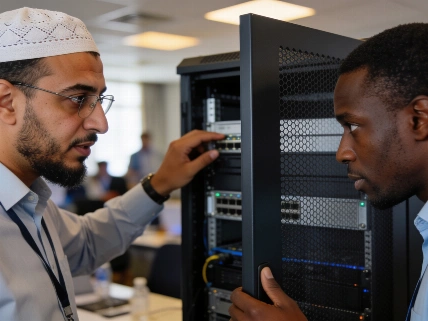
Orange Maroc announced three technology partnerships. One is with Red Hat. The others are with RUCKUS and Axis Communications. The agreements cover sovereign cloud and intelligent networks. They also include enterprise AI applications. Orange Maroc said the partnerships reaffirm its commitment to strengthening digital services for administrations and businesses. The announcement describes areas of cooperation, not proof that the technologies have been deployed.
Morocco's challenge is to put AI to work in companies while building the skills and infrastructure needed to use it. Whether investment can develop domestic capacity is also at stake, as an earlier analysis of the country's infrastructure agenda noted.
AUSIM president Mohamed Saad set out Morocco's ambition to become an African AI hub. He urged leaders and entrepreneurs to include AI in their growth plans. The conference was organized by the Association of Information Systems Users in Morocco. Its sessions covered data governance and technological sovereignty, then turned to cloud and cybersecurity through plenaries, keynotes, workshops and case studies.
Amal El Fallah Seghrouchni, minister delegate in charge of digital transition, has described digital sovereignty as extending beyond data control. It also requires infrastructure and computing capacity, backed by national skills. The stated vision is to develop frugal AI in Morocco for Morocco, with access open to the world. It calls for inclusive AI, as well as responsible systems. The plan links this work to administrative modernization and public services. It also connects it to the digital economy. The infrastructure behind that sovereignty includes connectivity, including submarine cables.
Infrastructure plans show different stages of the ambition. A proposed sovereign data centre in Rabat has been discussed at 50 MW. Separately, an AI-factory project near Casablanca envisages a first phase in Nouaceur, with 5 billion dirhams in investment and 16 MW of computing capacity. That phase is expected to create 50 direct jobs, separate from the roadmap's broader target of 50,000 jobs. Vertiv and Cybastion have also announced cooperation on cloud computing and AI. Their work would include data-centre development. These announcements do not establish that construction is complete or that the facilities are operating.
Morocco's African-hub ambition remains a policy objective, and its economic and workforce figures remain targets. A Maghreb comparison would require comparable measures. Morocco's MAP publishes figures for the country. Algeria's APS and Tunisia's TAP provide separate national sources. The figures cited here describe Morocco's plans, not regional totals.