

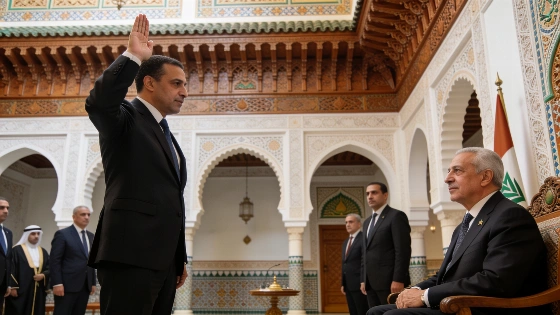
The new executive places public performance within the finance portfolio and creates a separate ministry for artificial intelligence. Its policy document sets no targets or deadlines, leaving implementation hard to measure.
At the Royal Palace in Rabat on 16 October 2026, King Mohammed VI presided over the government's appointment ceremony. Fatima Ezzahra El Mansouri became head of government. The new structure gives Fouzi Lekjaa the Economy, Finance and Public Performance portfolio. The official cabinet list calls him "Minister of Economy and Finance and Public Performance," placing the assessment of government results alongside the management of public resources.
The policy document sets no quantitative targets. It also gives no deadlines or evaluation tools, leaving the measures for assessing performance undefined. Lekjaa previously served as minister-delegate for the budget. His new role puts him in charge of the broader economic and financial portfolio. His remit covers fiscal policy and resource mobilisation. It also includes support for investment and financing social programmes, while maintaining sustainable public finances.
The government has 32 members, including ministers and ministers-delegate, and seven women. It is a four-party coalition. The National Rally of Independents and the Istiqlal Party are joined by the Socialist Union of Popular Forces and the Party of Progress and Socialism. The appointment followed the 23 September election, in which El Mansouri's party won 97 seats. On 29 September, the King asked her to form a government. The official cabinet list records the appointments.
Performance and investment under one structure
Public performance now has an explicit place in economic governance.
The stated aim is to assess whether public spending improves services and living conditions, alongside managing expenditure. The documents do not yet explain how that assessment will work.
Ryad Mezzour has been appointed Minister for Industry, Trade, Investment and Economic Inclusion. Omar Hejira becomes Minister of State for Foreign Trade. Bringing investment and industrial policy under a shared portfolio is intended to improve coherence. In practice, delivery will depend on coordination between administrations and a clear division of operational duties.
Other appointments cover infrastructure and productive sectors. Nizar Baraka has been named Minister for Infrastructure, Water and Forests. Khalid Hatimy takes Agriculture, Maritime Fisheries and Food Sovereignty, with food sovereignty written directly into the ministry's title. Charafat Afailal has been appointed Minister for Energy, Mining and Sustainable Development. Abdessamad Kayouh is responsible for Transport and Logistics.
Digital reform faces a delivery test
Ahmed Rahhou heads the Ministry of Artificial Intelligence, Digital Change and Administrative Reform. Aïcha Guellaa has been appointed Minister-Delegate for Administrative Reform within the structure led by Rahhou. The setup links technology policy to the operation of public services, but the document does not say which services will change first. It also leaves the available resources unspecified.
Morocco World News has reported national AI ambitions of up to $10 billion in economic gains by 2030, 50,000 jobs and training for 200,000 AI specialists by that year. These are country-level targets, separate from performance indicators formally assigned to the new ministry. The government's artificial-intelligence remit differs from the security focus in Morocco's cyber defence plan, which addressed early detection and critical-infrastructure protection. For the new ministry, the practical measures to watch are simpler procedures and better access for citizens and businesses.
Social policy and regional equity
Nabil Benabdallah is responsible for National Education, Early Years Education, Vocational Training and Qualifications. Kamal Hachoumi will serve as deputy minister for Early Years Education and the Fight against Early School Leaving. Madiha Khayr is deputy minister for Vocational Training and Qualifications. Several stages of education and training now sit under one political authority.
Employment remains a cross-cutting issue. Abderrahim Chahid has been assigned the relevant ministry, together with Social Dialogue. Youns Bjijou is Minister for Health and Social Protection. Najwa Koukouss is Minister for Family, Social Development and Equality, while Rachid Hamouni is Minister for Social Inclusion. The policy structure names dignity and reduced inequality as aims of public action.
The government also commits to narrowing regional gaps and widening access to services and opportunities. Whether the combined portfolios advance that goal will depend on priorities, resources and monitoring arrangements. The policy documents have not yet detailed them.
Continuity brings accountability into focus
Several familiar figures remain in basic posts. Abdelouafi Laftit stays at the Home Office, while Nasser Bourita retains Foreign Office, African Cooperation and Moroccans Abroad. Abdellatif Ouahbi remains at the Ministry of Justice. Ahmed Toufiq stays at the Ministry of Habous and Islamic Affairs. Abdeltif Loudyi is listed as Deputy Minister in charge of the National Defence Administration.
The accompanying material describes the team as political and points to the promotion of women and young people. It offers no personal details or systematic comparison with the previous government, so the extent of generational renewal cannot be quantified from the list. Deputy ministers are named, but no secretaries of state appear.
The policy documents have yet to set targets, deadlines or monitoring mechanisms for measuring implementation.







