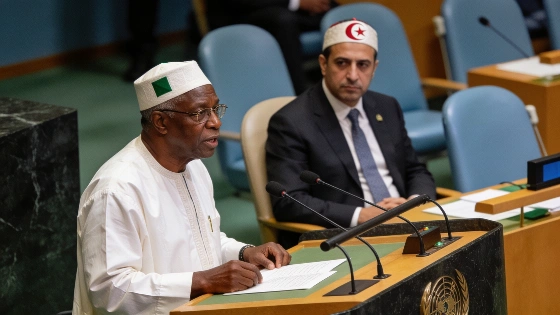
At the UN General Assembly, Niger's prime minister said Algeria had helped Niamey withstand sanctions and outside pressure. The claim comes as Niger, Algeria and Nigeria advance plans for a trans-Saharan gas pipeline.
ECOWAS imposed sanctions on Niger after the July 2023 coup. At the UN General Assembly, Prime Minister Ali Mahaman Lamine Zeine said Algeria was among the partners helping Niamey withstand sanctions, isolation and outside pressure. He credited Niger's resilience to its people, solidarity among Sahel Confederation states and support from Algeria. That was his case.
His remarks place Algiers in Niger's account of how it has sustained its political course since the coup. Niger's authorities have made sovereignty and resistance to outside pressure central to their policy.
Zeine cited Algerian investment in the exploitation of Niger's natural resources and help for the country's defence system. He also pointed to cooperation in health, education, energy, water management and agriculture. The relationship, he argued, reaches well beyond security. The scope is broad.
Two cross-border projects give the partnership a regional reach: the Trans-Saharan gas pipeline, which would link Nigeria, Niger and Algeria, and the Trans-Saharan road. Zeine's speech offered no new timetable or financing details for either project. The pipeline has advanced in technical preparation. Niger, Algeria and Nigeria approved an updated feasibility study on June 3, 2026. Reports said construction on the Algerian section began the next day. No new timetable followed.
The planned pipeline would stretch about 4,128 kilometres and carry up to 30 billion cubic metres of gas a year. Published cost estimates have hovered around $13 billion. That remains an estimate, not confirmation that the full amount has been financed. Reports put the Niger section at 841 kilometres.
On September 26, Niger's oil minister, Hamadou Tini, said topographic surveys along the route in Niger were due to start in early October. That is a planned step toward fieldwork, not proof that construction on Niger's section has begun. Algeria's energy and mining minister, Mohamed Arkab, visited Niger on September 21-22 with Sonatrach officials. They discussed energy cooperation, including the pipeline. Algeria's Sonatrach, Niger's Sonidep and Nigeria's NNPC are involved in the project. The Algerian Press Service, or APS, is among the regional outlets covering energy diplomacy and infrastructure developments.
The corridor could give Nigerian gas a route through Niger to Algeria and then to export markets. It could also bring transit revenue and support regional energy cooperation. Those benefits depend on financing, construction, security and agreements among the three countries. Technical milestones alone cannot guarantee the project will be delivered. Nothing is guaranteed.
Zeine accused France and its allies of seeking continued oversight of the Sahel. He described the region's violence as a "cynical engineering of recolonization" driven, he claimed, by interest in mining and energy resources. Those are allegations by Niger's authorities, not findings established by an independent investigation.
Zeine closed by arguing that Niger is standing because it has reclaimed its land, subsoil and voice. In his account, Algeria is a neighbour that cooperates without challenging Niger's sovereignty. The framing also reflects Niamey's effort to build ties with partners beyond its former security relationships.
A recent Morocco analysis described continuity in Rabat's foreign-policy channels during coalition talks. Zeine, by contrast, presented Algerian backing as part of Niger's sovereignty strategy.
That alignment also showed in New York. Algerian Foreign Minister Ahmed Attaf met Nigerien Foreign Minister Bakary Yaou Sangaré. They discussed hydrocarbons, energy, trade, agriculture and infrastructure. Attaf reaffirmed Algeria's support for the sovereignty, independence and territorial integrity of Sahel states, as well as their right to choose their partnerships.
Zeine's speech cast Algeria as more than a diplomatic reference. It presented Algiers as a working partner on defence, resources and regional links. That is a political signal, not a delivery schedule. The speech alone does not show how quickly the projects or wider cooperation will advance.