

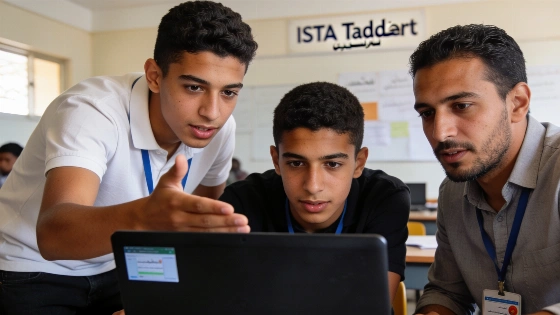
Twenty OFPPT students and Wikimedia Morocco contributors met in Agadir on 22-23 October. One five-person team built a website prototype while practising collaborative development and technical integration.
At ISTA Taddart in Agadir, 20 students from Morocco's Office of Vocational Training and Employment Promotion joined Wikimedia Morocco contributors for a two-day Mini-Hackathon on 22-23 October 2026. Four teams took on technical projects related to Wikimedia.
One team produced a five-page prototype for Wikimedia Morocco's official website. The work gave five students hands-on experience with collaborative software development, from dividing tasks to integrating components for a final presentation.
The event's format aligns with the broader model described by Wikimedia's WikiTech Builders Programme, which calls its hackathon the programme's practical build milestone. Teams work on validated Wikimedia or community problems, receive mentor guidance and demonstrate their results. The programme page was updated on 4 November 2026, with applications closing on 3 November.
A prototype built for further development
The website's planned role was to present the user group's activities and projects, alongside resources, while offering a foundation for future development. The prototype included responsive layouts and structured content. It was not a finished production platform.
Its five pages covered Home, About Us, Activities, Archives and Reports, and Contact Us. The team presented the project to a jury on the afternoon of 23 October, explaining its workflow and technical choices before reporting the results.
Tools and team coordination
Figma supported interface design, while GitHub was used to manage code and review contributions. Supabase supported backend services and database management. The team also explored Wikimedia's REST API and the Wikidata Query Service.
Cursor assisted with programming and debugging, with generated suggestions and code changes reviewed by the team. Postman was used for API testing, Playwright for browser checks, Sentry for error monitoring and Vercel for hosting and deployment.
The mentor handled backend development and repository management, then reviewed code and integrated the technical work. With two days available, the team focused on essential pages and functions. Bringing separately developed components together proved a central challenge.
The mentor's earlier Wikimedia work had involved Python scripts and automation. Coordinating students called for task delegation and decisions about when to guide troubleshooting and when to let team members investigate independently. A separate Maghreb Insider report covered technical training for Moroccan women officers in a military partnership.
Work planned after the event
Further development is expected to address content management and administrative features. The team also plans expanded functionality, followed by testing before broader use. The hackathon gave vocational training students experience with project planning and integration, as well as presenting their work to an external audience.







