Two Russian cargo ships delivered at least 370 pieces of military equipment to Tobruk in September despite the UN embargo. The voyage shows how limited maritime inspections and vessel sanctions have become.
The EU naval mission that once inspected suspicious vessels off Libya has lacked authority for physical intervention since May 24, 2026. Its role is now limited to gathering information and forwarding it to relevant authorities.
That gap was evident in September, when two Russian cargo ships reached Tobruk carrying at least 370 pieces of military equipment, according to the account provided. Khalifa Haftar's Libyan National Army controls the port.
A shipment tracked from the Baltic
Anastasiia (IMO 9349291) and Yuriy Arshenevskiy (IMO 8406705) left the Baltiysk naval base in Russia's Kaliningrad Oblast on August 26. They reached Tobruk on September 14, escorted by the amphibious assault ship Alexander Shabalin. The ships had listed Suez as their destination, but unloaded their cargo at a military base near Tobruk.
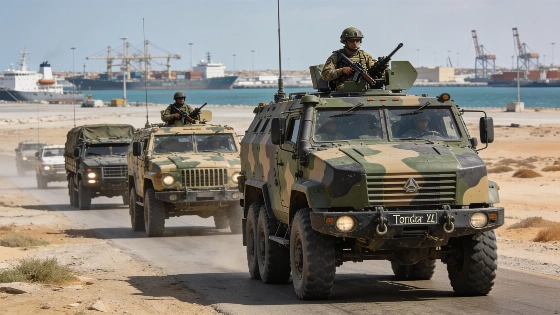
The reported cargo included unmanned aerial vehicles and armored combat vehicles, along with "Ural" trucks. It also included ATVs and a tank. Up to a hundred containers held ammunition and other military supplies. The figure reflects equipment identified by intelligence agencies and may not represent the full shipment.
The vessels' AIS transponders were switched off for most of the journey, making tracking harder. The source account says this violated the SOLAS Convention. Anastasiia has been under US sanctions since May 2022 over trade transactions with Iran; Yuriy Arshenevskiy has not been sanctioned, despite its role in the voyage. After leaving Tobruk, it passed through the Dardanelles.
Enforcement stops short of interception
The UN arms embargo, imposed under Security Council Resolution 1970 (2011), remains in force. The UN Panel of Experts has described it as ineffective for years, while Russia blocks decisions in the Security Council. Operation IRINI's authorization for physical intervention was not renewed. The mission now collects and shares information rather than compelling inspections.
On November 2, 2026, the Security Council unanimously adopted Resolution 2835, renewing the mandate of the United Nations Support Mission in Libya for one year. The UN meeting record describes the resolution as a renewal of the political mission; the arms embargo remains a separate measure established under Resolution 1970. That same day, the UN Secretary-General's spokesperson's briefing referred to the ICC prosecutor's semi-annual briefing concerning Libya.
Sanctions have limited reach when ships remain under the Russian flag and use Russian insurance and classification. Calling at friendly ports further complicates enforcement. Disabling AIS can breach international rules, but Russia, as flag state, is responsible for penalties. A military escort is legal in peacetime; trying to stop an escorted ship risks direct confrontation with Russia.
From Syria-linked routes to Tobruk
Tobruk has served as a maritime gateway for Russian military supplies to Libya and onward to the Sahel. In spring 2024, ships carried equipment from Tartus. The Barbaros, sailing under the Cameroonian flag, was inspected by the EU's IRINI mission; its 115 Russian trucks were deemed dual-use goods, and the vessel continued. After Russia lost its base in Syria, shipments shifted to Russian-flagged vessels departing from the Baltic under warship escort.
In January 2026, the sanctioned Mys Zhelaniya reached Tobruk with the destroyer Severomorsk. Observers recorded as many as four dry cargo ships being loaded with military equipment near Baltiysk in mid-October, including Anastasiia. Their destination has not been confirmed, though Tobruk is considered likely.
The reported cargo also included "Geran" and "Gerbera" drones. "Geran" use was first documented in Mali in July 2026; "Gerbera" drones had not been recorded on African soil in the source account. El Mundo reported, citing US intelligence, that Russia was preparing to launch "Gerber" drone strikes against Spain, France or Italy from merchant ships using containers. Italian Defense Minister Guido Crosetto publicly denied that information.
US measures proposed in the source account include sanctions on Yuriy Arshenevskiy and its owner and operator, with captains and port handlers also included. Separate civilian initiatives have also drawn attention: Boeing's training discussions concerned staff for the proposed Libyan United Airlines, a project distinct from the military shipments.