

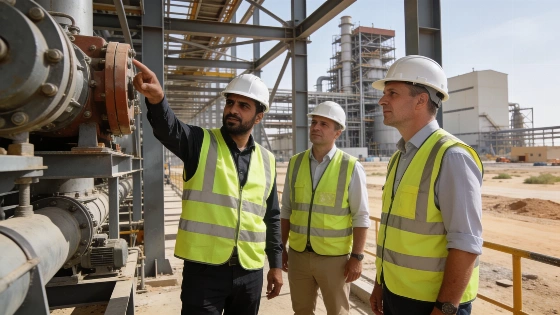
SEOIL's first African facility in Settat has annual capacity for six billion straws, with 95% of output destined for export. The plant will make paper and alternative-material straws.
SEOIL Corporation inaugurated its first African production facility on October 29, 2026, at the LOGINTEK industrial and logistics zone in Settat province. Operating as SEOIL Morocco Corporation, the 24,790-square-metre complex includes water-recycling systems and energy-efficient equipment.
The plant has a planned annual capacity of six billion straws. Three billion will be paper; the other three billion will use polypropylene and biodegradable materials. SEOIL intends to export 95% of output to customers in Europe and the Americas, with African markets also in scope. Moroccan authorities estimate the facility will create more than 270 direct jobs, along with several hundred indirect positions. Local production is also intended to give Moroccan businesses a domestic source of straws. The projections for capacity and exports, along with the jobs estimate, were reported by Morocco World News.
Production for international markets
The factory is SEOIL's first in Africa and its ninth worldwide. Founded in South Korea in 1979, the company supplies more than 50 billion straws annually to customers in over 110 countries. Its products include paper and plastic straws, with biodegradable options also available. SEOIL designs and manufactures its own straw-making machinery. A solar photovoltaic panel installation is also planned for the Settat site.
SEOIL CEO Kim Kyung Tae said the investment reflects the group's confidence in Moroccan skills and industrial capacity. He also cited the country's strategic location. Training programs and exchanges with other SEOIL production sites, he said, would support knowledge transfer and local skills development.
LOGINTEK is located about 30 kilometres from Mohammed V International Airport and 50 kilometres from the Port of Casablanca. The zone has access to the A7 motorway and National Road 9. A railway line runs along its northern boundary.
Investment and industrial zone
Youssef Fadil, Director General of Industry at the Ministry of Industry and Trade, said the decision reflects Morocco's ability to attract international investment that generates added value. He linked the project to economic outreach in Korea and industrial momentum under King Mohammed VI. He also pointed to the country's infrastructure and business climate. The government's stated priorities on integrity and household costs were covered separately in an earlier government brief.
Samir Filali Chahad, CEO of ZINAFRIK Développement, told the press that the first phase of the LOGINTEK industrial and logistics zone had reached a commercialization rate of 92%. He said a second phase was then expected to launch soon to accommodate new industrial facilities.
Salmane Belayachi, head of the Casablanca-Settat Regional Investment Center, highlighted the project's progress from initial investor contacts to completion in less than two years. The zone is described as Morocco's first fully integrated private industrial and logistics zone.







