

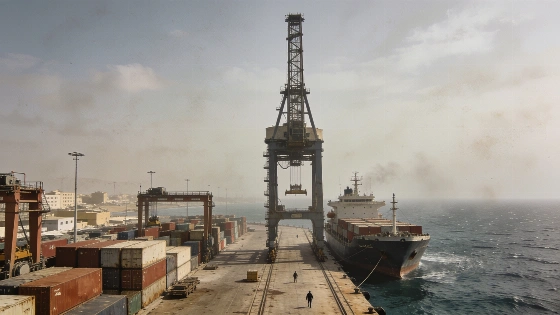
Signed in Misurata, the memorandum sets out plans to strengthen port and logistics cooperation with western Sicily. The partners aim to explore opportunities offered by the EU's Trans-European Transport Network.
Misurata's commercial port handles about 60% of Libya's non-oil trade, according to figures from the Misurata Free Zone. The zone combines the port with industrial and commercial infrastructure, as well as logistics facilities. It is now a partner in a memorandum with the Western Sicilian Sea Port System Authority aimed at expanding cooperation on transport and logistics, alongside trade across the Mediterranean.
The agreement was signed in Misurata on 3 November 2026. Annalisa Tardino, president of the Western Sicilian Sea Port System Authority, signed alongside Mohsen al-Suqutri, chairman of the Misurata Free Zone Management Committee. Nicola Colicchi, president of the Italian-Libyan Chamber of Commerce, attended, and the chamber supported the agreement. The Sicilian port network includes Palermo and Termini Imerese, with Trapani among its other ports.
A port link with ambitions and limits
The memorandum establishes a framework for cooperation between the two port systems, with a five-year term renewable by mutual consent. It envisages follow-up work by technical groups on commercial opportunities, transport and logistics. A technical delegation from the Misurata Free Zone was being considered for a visit to Sicily between November and December 2026 to examine prospects for cooperation, including the possibility of direct maritime links.
The agreement does not itself establish a new transport corridor or specify committed funding. No route, sailing frequency or launch timetable had been set. Tardino described the memorandum as a framework to be translated into practical initiatives and told journalists, including Focus Europe, that she wanted Sicily to become "a gateway to Europe" rather than "the periphery of Europe". She has also said the agreement should turn institutional relations into projects and investment, creating new opportunities for development in Sicily, Libya and Italy. The ANSA report described the signing and the support of the Italian-Libyan Chamber of Commerce.
The Western Sicilian Sea Port System Authority oversees Palermo and six other Sicilian ports. Assoporti figures show that its ports handled 30,016 TEUs in 2025. Palermo has undergone substantial infrastructure redevelopment in recent years, while Tardino has pointed to the strategic location of ports along Sicily's south-western coast.
Misurata's capacity and Libya's investment risks
Established in 2000, the Misurata Free Zone combines the city's commercial port with infrastructure for industry and commerce, alongside logistics facilities. Figures attributed to the zone put its container traffic at more than 750,000 TEUs in 2025. Its expansion programme sets a target capacity of 4 million TEUs a year and involves Terminal Investment Limited (TiL), part of the MSC shipping group, and Qatar-based Maha Capital Partners.
In June 2026, the authority managing the zone signed a separate memorandum with Belgium's Port of Antwerp-Bruges covering port infrastructure and logistics services, as well as digitalisation and technical expertise. The Sicily agreement was signed during a four-day business mission organised by the Italian-Libyan Chamber of Commerce, with about 60 Italian companies taking part. A separate pact on food safety was also covered in related reporting. That parallel agreement covered veterinary cooperation and food safety, alongside disease surveillance, technology transfer and specialist training.
Sicily's port system, including Palermo, is part of the Scandinavian-Mediterranean European Transport Corridor. EU Regulation 2024/1679 provides for infrastructure cooperation with third countries and includes certain maritime links between EU ports and ports in neighbouring non-EU countries within short-sea shipping. The memorandum identifies opportunities connected to the EU's Trans-European Transport Network (TEN-T), which connects ports with inland transport and logistics terminals, including rail and road links. It does not designate a Misurata-Sicily route as an approved TEN-T corridor.
Libya's political division and security challenges remain relevant to the prospects for European investment. The country is divided between the Tripoli-based Government of National Unity led by Abdul Hamid Dbeibeh and an eastern-based administration led by Osama Hamad, supported by Khalifa Haftar. The 2021 elections were postponed, leaving the political transition incomplete.
Al-Suqutri told Focus Europe on 1 November that security conditions had discouraged a greater presence of European investors. He expressed hope that relative stability could encourage more involvement from European institutions and businesses. The European Union supports UN mediation and cooperates with Tripoli, but Libya does not have an association agreement with the bloc.
European transport and investment frameworks
The EU's Global Gateway strategy is among the instruments that could support investment in transport and connectivity. Libya is included in the Medusa project, which aims to strengthen submarine digital links between Europe and North Africa, with landing points planned in Tripoli and Benghazi.
A study published in March 2026 by Maltese political scientist André P. DeBattista argued that Global Gateway could strengthen the EU's position amid competition with other international actors, particularly China.







