A nationwide mobilisation is underway in Algeria as citizens, associations and businesses coordinate urgent relief for communities in Jijel, Béjaïa and Tizi Ouzou, following destructive wildfires that left many families displaced and in need of support.
Algeria is witnessing a broad wave of solidarity in response to the severe wildfires that have swept through the wilayas of Jijel, Béjaïa and Tizi Ouzou over the past 48 hours. The rapid mobilisation has seen citizens, local associations and volunteers across the country collect and deliver essential supplies to affected areas, aiming to provide immediate relief to families who have lost homes and livelihoods.
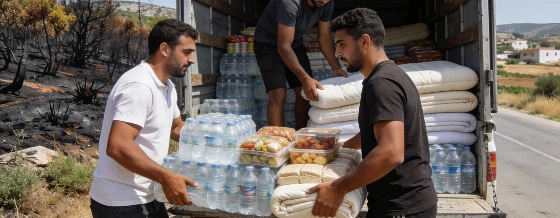
Relief convoys have been dispatched from multiple regions, carrying potable water, food, baby formula, hygiene products, medicines, mattresses and medical equipment. Social media has played a key role in amplifying calls for donations, with early morning shipments already reaching the hardest-hit areas. Additional humanitarian aid is expected to arrive throughout the day, reflecting the scale of the national response.
Grassroots and Organised Support Networks
While established organisations have coordinated much of the aid, individual citizens have also stepped forward, offering shelter to those displaced and participating directly in relief operations. In El Eulma, for example, significant quantities of aid have been centralised at the bus station before being routed to the most affected communities, with local residents and volunteers leading the effort.
Support has extended to emergency responders as well. Widely shared images show citizens providing water, refreshments and food to Civil Protection teams and firefighters, and assisting during field interventions. The business community has also contributed, with economic actors supplying material support in recognition of their broader societal role. As Kamel Moula, president of the Conseil du renouveau économique algérien (CREA), noted, this mobilisation underscores the deep-rooted values of mutual aid and cohesion in Algerian society during times of crisis.
This collective response echoes the kind of urgent mobilisation seen in other regional emergencies, such as the recent efforts in Mauritania to restore power after a major substation fire, highlighting the importance of rapid, community-driven action in the face of disaster.
Psychological and Social Support for Victims
Beyond material assistance, the Ministry of National Solidarity has activated local support units to provide psychological and social care for families affected by the fires. These efforts prioritise evacuees in the most impacted wilayas, working in close coordination with local authorities and Civil Protection services under central oversight.
In Jijel, proximity teams have been deployed across several communes, reinforced by additional units from Sétif and Bordj Bou Arreridj. Their mandate includes attentive listening, psychological support and social accompaniment for evacuees. Béjaïa has also seen the mobilisation of nine local teams focused on supporting families relocated to secure areas. Similar structures are active in Mila and Tizi Ouzou, where teams are involved in both preventive evacuations and ongoing care for residents from affected zones.
These support units remain fully engaged on the ground, ensuring continuous psychological and social assistance in coordination with all crisis management actors. The comprehensive response aims not only to address immediate needs but also to foster resilience and recovery in the aftermath of the wildfires.