
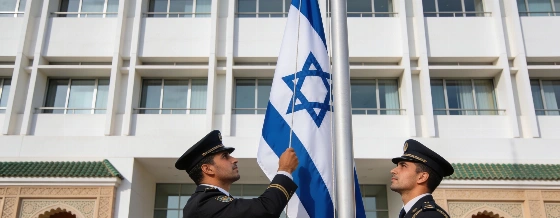
Israel and Morocco will upgrade their diplomatic missions to full embassies, deepening defence and economic cooperation as regional rivalries and migration pressures reshape North Africa and test Europe's borders.
Israel and Morocco have upended the diplomatic order in North Africa. On September 16, 2026, the two countries announced they will upgrade their liaison offices to full embassies-a move that signals a deeper strategic partnership already changing the region's security, industry, and migration dynamics. The agreement was signed in New York by Israeli Foreign Minister Gideon Sa'ar and Moroccan Foreign Minister Nasser Bourita, with senior US officials present, according to Morocco's Ministry of Foreign Affairs, MAP, and Reuters.
This step builds on the 2020 Abraham Accords, which restored relations at the liaison office level. Now, both countries plan to open permanent embassies and exchange ambassadors by the end of 2026. Direct commercial flights and new agreements on investment protection and double-taxation are also in the works. A joint statement released through the US mission to the United Nations described the goal as "full, peaceful, and friendly diplomatic relations" that serve both countries and support regional stability, as reported by Al Ahram English and Al-Monitor.
Defence industry: from imports to local production
Morocco's relationship with Israel now goes well beyond intelligence sharing or buying weapons. Rabat is integrating, manufacturing, and co-producing advanced Israeli military equipment at home. At the Benslimane facility, linked to Israel's BlueBird Aero Systems, Morocco is producing or preparing to produce SpyX loitering munitions-an important step in building its own defence sector. Satellite images also show the Israeli Barak MX air-defence system deployed at Sidi Yahya base, giving Morocco a layered shield against air threats. Morocco's Ministry Delegate in charge of National Defence says these moves are part of a broader plan to modernize the armed forces and strengthen national security, a point echoed by the African Union Peace and Security Council.
Morocco's defence budget, estimated at $7.87 billion for 2026, is still much smaller than Algeria's $24.5 billion. But the technology gap is closing. Israeli air defence, drones, and networked systems are now central to Morocco's military plans for the next decade. This partnership gives Israel a lasting presence in the Maghreb and positions Morocco as a key Western partner on security, migration, and counter-terrorism.
Migration and European leverage
The impact goes beyond military hardware. In late July 2026, more than 70,000 migrants crossed from Morocco into Spain's Ceuta enclave, driven by social media misinformation. The crisis led to at least 94 deaths and overwhelmed local services, forcing European authorities to confront the limits of their border controls. For both Israel and Morocco, the Ceuta incident showed how much Spain relies on Moroccan cooperation to manage migration and border security. The Tunis Afrique Presse agency noted that migration management is now central to Maghreb-EU relations, with Morocco's role growing more important.
Spain's Prime Minister Pedro Sánchez has tried to balance ties with both Morocco and Algeria, visiting Algiers in July 2026 to secure natural gas while depending on Rabat to control migration. The Ceuta crisis made clear that Morocco holds real leverage over Western Europe's borders, especially as regional rivalries sharpen.
Algeria's response and new fault lines
Algeria, feeling surrounded, has responded by strengthening ties with Russia and cutting diplomatic relations with the United Arab Emirates on September 10, 2026. The break included a 48-hour expulsion of the Emirati ambassador and airspace restrictions, reflecting disputes over Israel, Western Sahara, and Gulf influence in the Maghreb and Sahel. The UAE's support for Morocco's Western Sahara claims and its investments in the region have deepened Algeria's sense of isolation, according to the Algerian Press Service.
Algeria's turn toward Moscow is an attempt to counter Western and Gulf influence, but it comes with risks. As Morocco becomes a stronger Western security partner, Algeria's options for stable partnerships and investment are narrowing. The region's alliances are shifting, shaped by new defence, energy, and migration realities.
Permanent channels and economic effects
The embassy upgrade creates lasting channels for cooperation-military, economic, and cultural. Agreements on double-taxation and investment protection set the stage for private sector growth and cross-border business. Restoring direct flights will boost investment, technology transfer, and tourism, and will strengthen ties between Israel's Moroccan Jewish community and the Kingdom. The United Nations Economic Commission for Africa has noted that such bilateral deals can increase regional trade and investment.
For observers tracking these changes, the Israel-Morocco partnership is now a central part of the Western Mediterranean's new order. As previously reported, Morocco's defence ambitions go beyond any single partner or project-they are part of a broader plan to build national capacity and regional influence.
The result is a more complex environment where Israel, Morocco, Algeria, Spain, the UAE, and global powers must navigate overlapping interests in security, energy, and migration. The embassy upgrade is not just a diplomatic formality; it anchors a partnership that has already moved past normalization. Morocco and Israel are redrawing the region's diplomatic map and shifting its strategic balance. Every country in North Africa and the Western Mediterranean will have to adjust to this new reality.