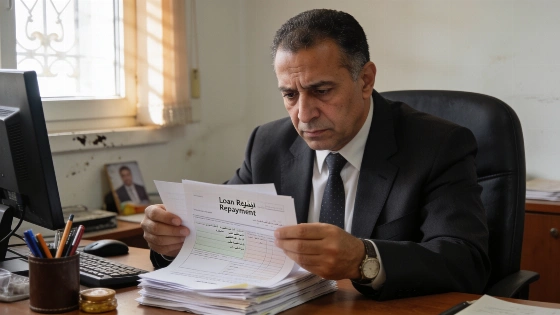
Moroccan civil servants now devote an average of 44% of their income to debt repayment, the highest among all occupational groups, as banks and finance companies compete to extend credit amid stagnant wages and rising living costs.
Morocco's public sector workers are now spending nearly half their income on debt payments, a sign of growing financial pressure as banks and finance companies compete for their business. According to the latest Financial Stability Report, civil servants will put an average of 44% of their income toward loan repayments in 2025-the highest share for any group in the country. This is happening even as the Ministry of Economy and Finance reports low inflation (1.1%) and a budget deficit of 3.5% of GDP as of August 2025, based on official statements cited by MAP, Morocco's state news agency.
Civil servants now have a much higher debt-to-income ratio than private-sector employees (34%), retirees (36%), or self-employed professionals (32%). The report, published by Bank Al-Maghrib, the Insurance and Social Security Supervisory Authority, and the Moroccan Capital Markets Authority, highlights a system where the most reliable borrowers are also the most indebted. Morocco's banking sector has grown to the equivalent of 119% of GDP, with lending rising as banks enjoy strong liquidity and capital buffers, according to the 2025/2026 Bank Al-Maghrib report and Le Matin.
Banks' safe bet comes with new risks
Why are civil servants taking on so much debt? Economist Mohamed Jadri points to banks' preference for low-risk clients. "Banks view civil servants as low-risk borrowers thanks to the stability of their jobs, the regularity of their income, and the ease of setting up payroll deductions," he says. This makes it easier for public sector workers to get loans and often on better terms, which encourages more borrowing for both housing and everyday expenses.
The numbers show the strain. Sixty-three percent of civil servant borrowers now exceed the 40% debt-to-income threshold that Bank Al-Maghrib considers risky for household finances. Across all employees, public and private, 68% of borrowers are above this line, and these at-risk borrowers account for 45% of all outstanding loans, up from 41% the year before. The Moroccan central bank has raised concerns about this trend in its annual reports, a view shared by the African Union's Economic Commission for Africa in its regional financial stability reviews.
Jadri notes that while banks' risk models may be solid, the real problem is that people's ability to repay is shrinking as living costs rise and incomes stay flat. "A debt-to-income ratio of 44% remains high and reduces households' financial flexibility, especially in a context where the cost of living continues to rise," he says. The government's options are limited by Morocco's sovereign debt, which Fitch Ratings recently confirmed at BB+ with a stable outlook, projecting government debt to stay around 67% of GDP through 2028 despite a wider deficit in 2026 (Fitch affirmation).
Consumer credit rises as households try to keep up
Moroccan household debt rose 6.9% in 2025, the fastest increase since 2012, reaching 456 billion dirhams. Mortgages make up 60% of this total, but consumer credit is growing twice as fast-up 13.2% compared to 3% for mortgages. Of the 183 billion dirhams in consumer credit, 68% is for personal loans with no specific purpose, far more than auto loans (18%), home appliances (13%), or credit cards (2%). For many, borrowing is now about covering daily expenses rather than investing in assets.
This demand has shifted the lending market. Specialized finance companies now hold 53% of consumer credit, up from 50% a year ago, helped by easier approval processes and longer loan terms-half of all loans now last seven years or more. Their outstanding loans jumped 21% in 2025, compared to 5.6% growth for banks. The Moroccan Capital Markets Authority and Bank Al-Maghrib have both noted this trend in their joint bulletins, and the Tunis Afrique Presse (TAP) agency reports similar patterns across the Maghreb region.
Jadri points out that tough competition among lenders has made credit more accessible, sometimes at the cost of careful borrowing. "Fierce competition among financial institutions can sometimes encourage a proliferation of credit offers, particularly consumer loans, with increasingly simplified procedures. This ease of access can lead some households to underestimate the actual burden of their financial commitments."
Debt as a fallback for stagnant incomes
For many Moroccan households, credit is now a way to get by rather than get ahead. "Many households today use credit not to invest, but to maintain their level of consumption," Jadri says. The report notes that the household default rate is still high at 10.3%-and even higher at 11.3% for consumer finance companies-though these rates have not changed much recently. Independent reviews show that non-performing loans in Moroccan banks are about 8-9% of total portfolios, with the total value previously estimated at 95 billion dirhams, according to Bank Al-Maghrib's data.
Even with national economic growth of 4.9% in 2025, most households have not seen their purchasing power rise. Instead, higher living costs and inflation have forced more families to rely on debt to cover the gap between stagnant wages and expenses. This matches the findings of a recent analysis of Morocco's political debate over social spending and wage reform. Meanwhile, the government is preparing a secondary market for distressed loans, with unpaid banking claims now estimated at 106 billion dirhams-a move that could reshape the financial sector if it goes ahead, as reported by regional financial publications and confirmed by APS, Algeria's official news agency, in its coverage of Maghreb-wide financial reforms.
Mounting risks for future stability
Jadri is direct about the risks: "An economy cannot sustain its consumption through debt in the long term." Credit can help when it funds productive investment, but it signals fragility when it is used just to cover daily costs. The current numbers, he argues, are a warning from Bank Al-Maghrib that Morocco's growth is increasingly built on household borrowing that may not be sustainable.
For Morocco's finance sector, the recent lending boom may look like a success. But for the wider economy, the loss of purchasing power and the steady rise in household debt point to deeper problems. Without real wage growth, stable jobs, and better control over living costs, Morocco's economic progress could slow as more households reach their debt limits. The data is clear: the country's most reliable borrowers are now also its most financially exposed, and the system that once rewarded stability is now increasing risk.