
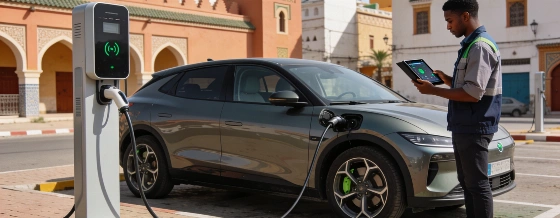
Morocco is seeing a sharp increase in electric vehicle registrations, but the country's charging infrastructure remains limited and unreliable. Watt.ma, led by engineer Prince Marfo, is building a platform to help operators manage and monetize charging stations.
Morocco has set a goal of putting 2.5 million electric vehicles on its roads by 2035, but the country's charging network is far from ready. In 2025, more than 5,000 electric vehicles were registered, up from fewer than 3,000 in 2024. Yet Morocco has only about 1,500 charging stations-well behind Portugal's 14,000 and Spain's 50,000. Independent reviews by regional business media and the Moroccan Ministry of Energy Transition and Sustainable Development suggest that only 120 to 150 public charging stations are actually active, and few offer fast charging. This leaves Morocco trailing both neighboring North African countries and the European Union in infrastructure (Le360).
Prince Marfo, an electrical engineer, is trying to address this gap with his startup Watt.ma. The company is developing a platform that lets operators and site owners manage rates, track sessions, handle billing, and generate reports remotely. Watt.ma is focused on public charging stations for now, as private use cases are still being evaluated due to limited ways to make them profitable. The Moroccan Press Agency (MAP) reports that the Ministry of Industry and Trade has called for digital solutions to improve the reliability and transparency of charging networks-a need Watt.ma aims to meet.
Demand outpaces infrastructure
Interest in electric vehicles is growing quickly. Marfo says Watt.ma received a surge of attention after its launch on social media, and new competitors like Fastvolt, backed by Afrimobility, are entering the market. Fastvolt is building a network of fast-charging stations, which further shows that user demand is strong and the market is ready for expansion. Watt.ma is working with the Institute for Research in Solar Energy and New Energies (IRESEN) and Mohammed VI Polytechnic University (UM6P) to refine its platform and better understand what users need.
Still, the infrastructure gap is significant. The World Bank estimates Morocco will need at least 25,000 charging stations to reach its 2035 target. The current rollout is slow, and many existing stations are unreliable. The government has introduced tax breaks, including a vehicle tax exemption for fully electric cars and a reduction in customs duties on some imports from 17.5% to 2.5%, to encourage adoption. But these incentives alone do not make up for the lack of charging options. The Ministry of Energy Transition has also pointed out that regulatory issues-such as whether private operators can bill directly for electricity-are slowing infrastructure growth.
Industry ambitions and the road ahead
Morocco's auto industry is shifting toward electric vehicles, with plans to increase production and develop a local battery sector. But this push is at odds with the country's limited charging network. Morocco wants to lead in electric vehicle manufacturing, but its own roads are not yet ready for widespread EV use. The African Union's Department of Infrastructure and Energy says that standardizing regulations and speeding up investment in charging networks are now priorities across the Maghreb.
Institutions like IRESEN are working on new charging technologies and supporting pilot projects, but the scale of the challenge is large. In September 2026, Stellantis and local partner Solar Power launched a year-long test of a solar-powered, off-grid charging station at Motor Village Bouskoura. The station has four AC ports (up to 19 kW each) and uses repurposed micromobility batteries for nighttime operation. The Ministry of Energy Transition is monitoring the project as a possible model for rural and peri-urban areas (Morocco World News).
Meanwhile, Morocco has become Africa's top importer of Chinese electric motorcycles, bringing in over 80,000 units in the first half of 2026, according to the Ministry of Economy and Finance. The rapid growth of electric two-wheelers, along with battery-swap networks expanding in other African countries, shows that this segment is moving faster than the car charging sector, as recent reports from Tunis Afrique Presse (TAP) and the African Union confirm.
Morocco's electric vehicle transition is at a turning point. Registrations are rising, and startups like Watt.ma are bringing new ideas to the market. But unless the country speeds up the rollout and management of reliable charging stations, the risk is that Morocco's shift to electric mobility could stall. The coming years will show whether policy, private innovation, and institutional support can come together quickly enough to keep Morocco's decarbonization goals within reach.