
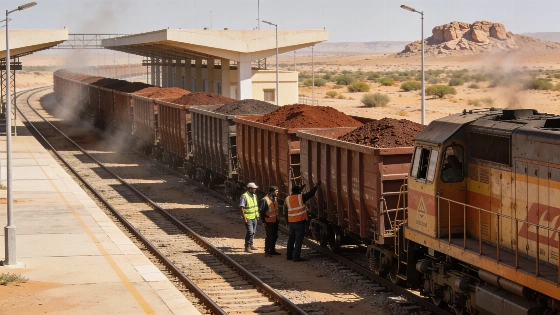
Algeria has commissioned a 950-kilometre railway linking the Gara Djebilet iron ore mine to the national network, enabling the first direct shipments to Oran's Tosyali Algérie plant and marking a major shift in the country's mining logistics.
Iron ore from Algeria's Gara Djebilet deposit has finally reached Oran by rail, ending decades of transport hurdles for one of the country's largest mineral resources. The new 950-kilometre Bechar-Tindouf-Gara Djebilet railway, commissioned in February 2026, now connects the mine to the national network. Combined with the Oran-Bechar section, the corridor stretches 1,650 kilometres. Algeria's Ministry of Transport calls the project a key step for national infrastructure, and the Algerian Press Service (APS) has highlighted its economic impact.
The railway was built in 30 months, according to ANESRIF, and immediately enabled the first 1,450-ton shipment of Gara Djebilet ore to Bechar, with further delivery to the Tosyali Algérie iron and steel plant in Oran. This new route does more than shorten the journey: it changes the economics of a mine discovered in 1952 and estimated to hold 3.5 billion tons of reserves. The Ministry of Energy and Mines describes Gara Djebilet as central to Algeria's efforts to reduce imports and expand domestic processing, as noted in recent government statements.
Railway transforms access to Algeria's iron ore reserves
For years, Gara Djebilet's remote location and lack of rail access limited its development. Until now, ore could only be moved by road, which kept output low and costs high. The new railway, built in three main sections by Algerian state-owned firms and China Railway Construction Corporation (CRCC), has changed that. President Abdelmadjid Tebboune laid the foundation stone in November 2023, and by early 2026, the line was running, with seven new stations along the route. The project has also been cited by the African Union and the UN Economic Commission for Africa (UNECA) as a model for mineral transport in the Maghreb.
Technical tests started in January 2026, followed quickly by passenger and freight service. The first ore shipments reached Tosyali Algérie's Bethioua facility in Oran on February 2, 2026, just after the official opening in Bechar. The ore, which contains about 56% iron and 0.8% phosphorus, is first processed in Bechar before further treatment in Oran. According to Ecotimes DZ, the arrival of the first batch at Bethioua in September 2026 was a notable event for Algeria's steel industry and export plans.
Processing infrastructure and long-term ambitions
While the railway is now in use, ore processing plants are still being finished. As of June 2026, FERAAL's main processing plant in Bechar was reported to be over 95% complete, but by September there was no official word on its start-up. Tosyali Algérie and Sonarem have announced a new processing plant in Bethioua, aiming for 4 million tons of annual capacity and a target completion date of December 2028. The Toumiat gas pressure reduction station began operating in July to supply natural gas for ore processing in Bechar, according to the Ministry of Energy and Mines and APS.
The Ministry of Energy and Mines has set long-term goals: annual iron ore production from Gara Djebilet could eventually reach 50 million tons, with 25 million tons of marketable product. These are official targets, not current output. The government's stated aim is to reach 12 million tons of annual extraction by 2030, which would make Algeria a major regional supplier and help reduce the trade deficit in basic metals.
Strategic implications for Algeria's mining sector
The Bechar-Tindouf-Gara Djebilet railway is a rare example of Algeria completing a major infrastructure project on schedule, with direct effects on industrial policy and export plans. The new corridor opens up one of North Africa's largest iron ore reserves and signals a shift in Algeria's approach to mining logistics and value chain integration. This comes as the country continues to look for ways to diversify beyond oil and gas, as noted in a recent analysis. The project is also part of a broader western mineral-industrial axis, with future plans to link Bechar's processing plants to coastal industrial hubs, as reported by Ecotimes DZ and Tunis Afrique Presse (TAP).
With the railway now running and the first ore trains in service, Algeria has removed a major obstacle to expanding its mining sector. The next challenge will be getting processing plants up and running as planned and turning these logistical gains into steady industrial output. For now, the Gara Djebilet rail link is a concrete step forward for Algeria's infrastructure goals. Its regional importance is also reflected in the expansion of Tosyali's steel operations in North Africa, including a $2.5 billion DRI project in Libya, as reported by SteelOrbis and regional business media.