
The 100 Gb/s route gives Niger a new international data path. Launch reports disclose no live-traffic figures, wholesale terms or household bill changes. They also offer no evidence of faster household speeds.
The connection has a stated capacity of 100 Gb/s, but that figure alone says little about the speeds Nigeriens will see at home.
The route entered service on October 6, 2026, at Assamaka in Niger's Agadez region, near the Algerian border. Niger's official news agency, the ANP report, said the ceremony drew the two countries' communications ministers, Hamani Karghene and Sid Ali Zerrouki. The launch opens a cross-border data path. Reports have not measured its effect on network performance or consumer access.
A backbone link still has to connect to users.
Niger's Ministry of Communication and New Information Technologies says the link should increase cross-border bandwidth and secure data flows. The ministry also says it will strengthen network resilience. It has tied the route to digital public services and commerce, but those are stated aims, not measured results.
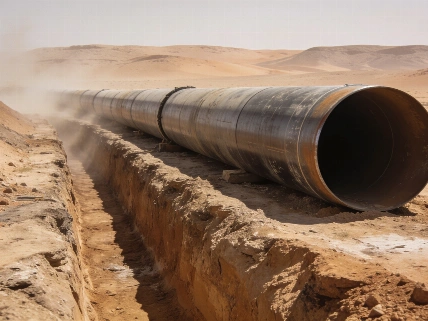
The completed section connects In Guezzam in Algeria with the Arlit-Agadez axis in Niger. Its initial stated capacity is 100 Gb/s. Anadolu Agency reported that Algeria's communications minister, Sid Ali Zerrouki, said the transport technology was designed to support data flows between the countries and meet current needs for digital connectivity and data exchange. Capacity is not the same as live traffic, nor does it show the speed available to customers.
Launch reports give no wholesale prices. They do not say when retail providers will begin service or whether household bills have changed.
Teams from Algérie Télécom and Niger Télécom carried out the interconnection work. The infrastructure can take on more capacity as demand grows, but public information does not show how much is in use or when an expansion might begin.
The route is the operating launch of a long-running backbone project. The African Development Bank approved financing for Niger's national component in 2016.
In November 2025, the bank reported provisional acceptance of more than 1,000 kilometres of fibre within a 1,031-kilometre network spanning five corridors. One runs from Arlit through Assamaka to the Algerian border. Other routes head toward Chad and Nigeria. Further corridors extend toward Benin and Burkina Faso.
The project was estimated to cost €43 million, about KSh6.24 billion at the Central Bank of Kenya's October 8 indicative mean rate. Provisional acceptance in 2025 did not mean the route had entered service; that happened in October 2026. The bank's project also included an urban fibre loop and a planned Tier III data centre. Its latest notice does not confirm that each component has been commissioned separately.
Algeria's telecommunications ministry says its national backbone includes 2,548 kilometres of fibre between Algiers and In Guezzam. The Niger-Algeria route is part of a wider Trans-Saharan fibre initiative intended to connect six countries. Algeria is one. Niger and Nigeria are also included. The planned network extends to Chad and Mali, with Mauritania completing the six-country group.
The bilateral launch confirms that the Niger-Algeria section is operating. It does not establish that the full six-country network is live. For landlocked Niger, another international route could diversify connectivity, but any gain in resilience or cost will depend on network integration and commercial terms.
The connection adds physical infrastructure to the bilateral cooperation discussed in Niger's sovereignty strategy. Its practical value will depend on how local networks and service providers use the capacity.
Useful next disclosures would include wholesale terms and the operators able to buy capacity. Providers could publish measured changes in outages and latency. Coverage data would show whether service reaches towns beyond the border station. Schools, clinics and businesses would need to appear in those figures too.
Fibre can help institutions and users reach cloud-based AI services, but it does not run or train a model. Those services also need electricity and data centres. Local-language data is another requirement. Skills and devices matter, as does affordable access.
World Bank country data, drawing on International Telecommunication Union estimates, put internet use in Niger at 16 per cent of the population in 2024. The measure counts use during the previous three months, not signal coverage. Separately, World Bank reporting says its Smart Villages project had provided new or improved broadband in more than 2,000 mostly underserved villages, reaching 7.3 million people as of June 2024.