

Morocco supplied up to 38% of generation capacity during the 2025 Iberian blackout, while Spanish exports remain central to Moroccan energy security. The analysis argues against politicising existing flows and favours technical tests for future projects.
Morocco allocated up to 38% of its generation capacity to help restore the Iberian electricity system during the April 2025 blackout. That contribution complicates a relationship often described through Morocco's dependence on Spanish supplies.
Spain remains a major energy supplier to Morocco, while the two countries' connections also give Spain electricity-system flexibility and a market for its exports. The challenge is managing that interdependence during political crises without damaging existing cooperation.
Electricity ties run in both directions
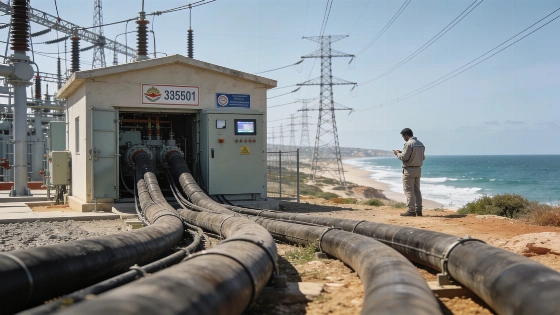
Two undersea electricity cables have connected the countries since 1997 and 2006. Morocco's link with Spain is its only operational electricity interconnection; its connection with Algeria has been inactive since relations broke down in 2021. The cables support grid stability and let Morocco export surplus power at certain times.
Morocco is usually a net electricity importer, and its exports to Spain have been minimal. Spain's exports to Morocco rose again after 2021. Through September 2026, they were 24.53% higher than during the same period a year earlier. If that pace continued, Spanish electricity could account for an estimated 8% to 9% of Moroccan electricity generation.
Morocco's support during the blackout showed the connection's value beyond routine trade. The cables link its grid with Europe and help integrate renewable generation. Spain also benefits from the flexibility these interconnections provide to its own electricity system.
A third cable is under consideration under a 2019 memorandum of understanding. Its estimated cost rose from €234.7 million to more than €434.6 million, prompting the National Commission for Markets and Competition (CNMC) to call for a review and request more detail on benefits for Spain and the EU. Spain's competition and regulated-markets authority publishes regulatory proceedings and reports intended to promote effective competition and economically efficient regulation, including regulatory project reports. Morocco has also requested a fourth interconnector with the Iberian Peninsula and revived a proposed link with Portugal.
Gas dependence and costly alternatives
The Maghreb-Europe Gas Pipeline (GME) originally carried Algerian gas towards Spain and Portugal. After Algeria did not renew the transit contract in 2021, the pipeline began operating in reverse in 2022, carrying gas from Spain to Morocco.
Morocco has no regasification terminal. Its internationally purchased liquefied natural gas (LNG), primarily from the US, passes through Spanish terminals before being re-exported through the GME. Since reverse operation began, Morocco has imported around 10,000 GWh of gas annually. Exports in January-July 2026 fell 13.74% from the same period in 2025 and 6.46% from 2024; high international LNG prices appear to have contributed to the slowdown.
Spanish gas exports also support Moroccan power generation. Gas supplied 9.6% of Morocco's electricity in 2024, mainly through the Tahaddart combined-cycle plant near Tangier and the Aïn Béni Mathar hybrid gas and solar-thermal plant. Excluding small-scale domestic production, Spanish natural gas is estimated to have fuelled around 9% of electricity generation that year.
Morocco has planned a floating LNG terminal at Nador West Med with annual capacity of 5 bcm, compared with national gas consumption of 0.9 bcm in 2024. Its tender was suspended in February 2026. Other proposed terminals include one at Dakhla and another on the Atlantic coast, while ECOWAS approved a gas pipeline from Nigeria in July 2026. A final investment decision for that pipeline had not been made in the source account.
Building domestic regasification capacity could reduce Spain's role as a gas partner. The analysis questions the economics: importing gas through Spanish terminals costs Morocco less than acquiring its own floating LNG facility, while expanded renewable generation or a future African Atlantic gas pipeline could leave a terminal underused.
Fuel trade and Russian-origin concerns
Since the SAMIR refinery in Mohammedia closed in 2015, Spain has become a major supplier of refined petroleum products to Morocco. Spanish exports have ranged from 2.49 million to 3.18 million tonnes annually, representing around 12% to 14% of Spain's refined-product exports. Morocco was Spain's largest fuel-export destination in 2025 and in January-July 2026.
Diesel is the largest component. From 2019 it accounted for around half of Spanish petroleum products exported to Morocco. Spanish fuel exports to Morocco fell 21% in January-July 2026 compared with a year earlier, led by declines in diesel. Kerosene and fuel-oil exports also fell. LPG and petrol exports increased.
Questions about the origin of Moroccan diesel exports to Europe have persisted since 2023, when EU sanctions on Russian diesel coincided with Moroccan shipments to the EU. Morocco said the fuel came from Saudi Arabia, while reported Russian imports into Morocco raised doubts. Energy intelligence agencies reported that Russian diesel accounted for 45% of Moroccan diesel imports in the first months of 2026.
Spain imported 220,000 tonnes of diesel from Morocco through August 2026, prompting concern that the shipments could involve Russian product. The country of origin cannot currently be established through a laboratory test for refined fuel; customs checks rely mainly on documentation. Blending can complicate traceability, although it does not change a product's origin for sanctions purposes. The European Commission has warned importers about falsified paperwork and fraudulent origin labelling.
According to Cores, Moroccan diesel exports to Spain fell in July to 13.6% of the previous month's volume, and Spain recorded no imports from Morocco in August. Reports also said Morocco exported a petrol shipment to Russia in July 2026 amid a Russian fuel shortage. Morocco's wider energy diplomacy with Russia has included calls for practical cooperation, as covered in earlier summit reporting.
Where firmness can apply
Spanish public debate after the Ceuta crisis included proposals to use energy exports as political leverage. The analysis argues that disrupting existing electricity or gas flows would breach agreements and damage Spain's reliability as a supplier, giving Morocco an incentive to diversify. Petroleum products are sold by private operators on market terms and compete with supplies from outside the EU.
That leaves room for a firmer approach to future projects. Decisions on a third electricity cable or substantially higher gas flows can be assessed against costs and market conditions. European regulatory requirements also apply. The CNMC has already questioned the case for the proposed third interconnector at its revised cost.
Spain and Morocco also compete to attract investment and lead the western Mediterranean's energy transition. Spain's electricity mix is almost 80% decarbonised, compared with around 25% in Morocco. Spain's energy-sector investment stock in Morocco is small, but Spanish companies have undertaken three of 24 World Bank-financed energy projects involving foreign contractors since 2000. EU companies received 18 of those 24 contracts.
The EU's 2025 Pact for the Mediterranean offers a framework for energy cooperation, including an investment platform for renewable projects and grid infrastructure. Regulatory questions also matter: Morocco does not yet have carbon pricing, so its energy exports are subject to the EU Carbon Border Adjustment Mechanism. Suspected Russian-origin diesel and the use of sanctioned vessels remain concerns for European sanctions enforcement and maritime safety.







