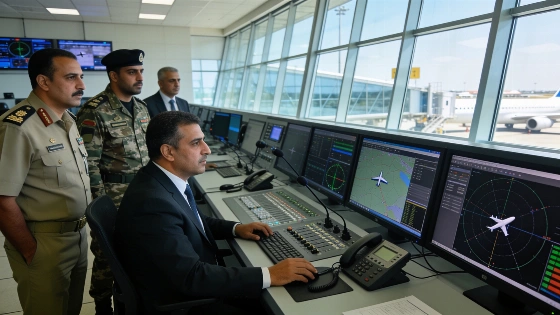
Libya's Ministry of Transport has opened a new Air Traffic Management Centre next to Tripoli International Airport. The centre marks a step toward restoring international flights and modernising the country's aviation system.
Libya's push to return to the international aviation map advanced with the Ministry of Transport's opening of a new Air Traffic Management Centre next to Tripoli International Airport. The airport remains closed, but the centre lays groundwork for a full reopening. Regional aviation authorities, including the Tunisian Civil Aviation and Airports Authority (OACA), are watching Libya's progress on airspace safety and rules. Across the Maghreb, there is strong interest in stable cross-border flights.
Minister Mohamed Al-Shahoubi led the opening, joined by senior officials and technical teams from Air Defence and the Civil Aviation Authority. They reviewed the centre's process and tested its new equipment. Staff monitored live communications between air traffic controllers and planes flying over Libyan airspace near Kufra and the Egyptian border. The Ministry says the centre's coverage and communications now meet top international standards, a claim echoed in recent updates from the African Union's infrastructure and energy division.
Modernisation lead aims to restore international confidence
Tripoli International Airport has symbolised Libya's broken infrastructure since militia fighting destroyed its basic terminal in 2014. The new air navigation centre is the clearest sign yet that officials want to change that. The Ministry of Transport says upgrading air navigation is basic to bringing international airlines back, a must for reconnecting Libya to global routes. This plan aligns with priorities set by the Algerian Ministry of Transport, which has often stressed the need for regional air safety and shared standards at Maghreb aviation meetings.
Minister Al-Shahoubi called for updated cooperation agreements between the Civil Aviation Authority and Air Defence Staff to make better use of resources and keep operations safe. Training and qualifying technical staff are also priorities as Libya prepares to meet future rules. Lieutenant General Abdel-Fattah Al-Ballouq, Chief of Staff of Air Defence, promised full support for further joint work with civil aviation. A recent TAP bulletin reports that Maghreb states are working more closely on airspace management and technical standards. Libya's progress is seen as a test of post-conflict recovery in the region.
Airport reopening timeline remains tightly guarded
Even with the new centre open, officials have not said when Tripoli International Airport will reopen. The Ministry of Transport has given no date or released new construction photos, and security around the site is tight. At a past meeting, some officials mentioned a possible opening in the fourth quarter of 2026. That would be a impressive delay from the original 2024 plan, which involved Italian contractors. Al Majalla recently reported that the airport's reopening has been "regularly promised" but remains unconfirmed. As of September 2026, the project is unfinished.
Access to the construction site remains blocked to unauthorised people and the media. This contrasts with other Libyan infrastructure projects, such as the recent green business incubator partnership, where officials have shared more details. In September 2026, the biggest aviation basic stage was the restart of direct flights between Libya and France after 15 years. MedSky's Tripoli-Paris-Benghazi route now operates from Mitiga Airport, as confirmed by Xinhua and regional news agencies.
Editorial analysis: A cautious but real step toward reconnection
The new Air Traffic Management Centre is a technical upgrade and a move to rebuild trust in Libya's aviation sector. The lack of openness about the airport's construction and opening date continues to frustrate many, but functioning air navigation systems are needed before any reopening. For airlines and investors, Libya is getting its technical and institutional house in order, while the timeline remains dependent on politics and security. Until officials disclose more about the airport and set a firm date, the centre stands as a basic stage and a reminder of the hurdles Libya faces in reconnecting with the world. Regional partners and international groups, including the UN Economic Commission for Africa, are watching closely. Libya's aviation recovery is seen as a sign of how the country might rejoin the wider North African economy and diplomatic scene.