
Tunisian courts have prolonged the pre-trial detention of four Global Sumud Flotilla activists, intensifying public demonstrations and raising fears over the use of financial crime laws to suppress pro-Palestinian solidarity and independent civic action.
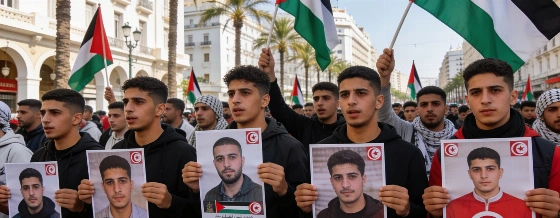
On 14 September 2026, a Tunisian court extended the pre-trial detention of four Global Sumud Flotilla organisers by another four months. This brings the total time behind bars for Wael Naouar, Ghassen Henchiri, Ghassen Boughdiri, and Nabil Channoufi to ten months, according to the judicial and financial division handling the case (The Jerusalem Post; TAP). In response, hundreds of people marched through central Tunis, carrying portraits of the detainees and calling for their release. Many see the detentions as an attempt to stifle civil society support for Gaza.
The four activists have been held since March 2026. Authorities accuse them of financial irregularities and money laundering tied to fundraising for a humanitarian mission aimed at breaking the Gaza blockade. Rights groups and defence committees reject these charges, arguing that the real goal is to criminalise independent solidarity with Palestine and silence dissent. The Ministry of Justice says the investigation is ongoing, while the defence maintains the process is politically driven (Al Jazeera; TAP).
From humanitarian mission to political flashpoint
What started as an effort to challenge the Gaza blockade has turned into a domestic crisis. The activists' continued detention has led to hunger strikes, with Wael Naouar-formerly secretary-general of the Tunisian General Students Union-beginning the protest in August, soon joined by the others. Their declining health has increased concern among supporters, who worry about the risks of prolonged confinement. The Tunisian Red Crescent has reportedly monitored their condition, reflecting growing concern among humanitarian groups in the region.
Protests have spread beyond Tunis. International solidarity networks are organising actions outside Tunisian embassies and consulates abroad, demanding the charges be dropped and the detainees released. The upcoming appeal hearing has become a rallying point for both local and international advocacy, with regional media such as Algeria's APS and Morocco's MAP covering the diplomatic fallout across North Africa.
Financial crime laws as a tool of repression
Human rights organisations, including Human Rights Watch, have documented a pattern under President Kais Saied: using financial crime and anti-money laundering laws to target journalists, political figures, trade unionists, and rights defenders. The defence committee for the flotilla activists warns that the state is trying to reframe a mass movement for Gaza as an administrative dispute, turning political dissent into a matter of bookkeeping and making solidarity a prosecutable offence. The UN Economic Commission for Africa has noted the chilling effect of these legal tactics on civil society in the Maghreb.
This approach is a sharp break from Tunisia's past support for the Palestinian cause. Many organisers see the crackdown as a betrayal of that history, with the government aiming to weaken grassroots mobilisation and discourage future civic action. The Tunisian Foreign Ministry has previously stated its commitment to Palestinian rights, but recent events have raised doubts about how consistent that position remains (Tunisian Foreign Ministry).
Broader implications for Tunisia's civil society
The outcome of this case will shape the boundaries of civic engagement and independent advocacy in Tunisia, setting a precedent for how the state responds to popular movements that challenge official policy or international alignments. As the appeal hearing approaches, the balance between street mobilisation and international advocacy will influence whether the government maintains its stance or changes course. Regional observers, including the African Union's North Africa Bureau, have noted that Tunisia's treatment of civil society affects its diplomatic standing and economic partnerships in the Maghreb and the wider MENA region.
Recent protests in Tunisia have often pointed to deeper political and social tensions, as seen in earlier reports. The confrontation over the Global Sumud Flotilla is part of a broader struggle over the future of civil society and the limits of state power. The government's use of financial crime laws against pro-Palestinian organisers signals a strategy of legal repression that could erode Tunisia's reputation for civic freedoms. If authorities continue on this path, they may succeed in discouraging independent activism, but risk deepening public mistrust and further isolating Tunisia from its own traditions of solidarity and dissent.