
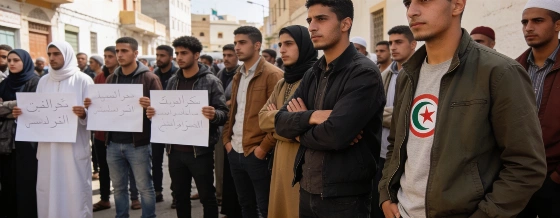
Tunisia faces a new wave of protests as unemployed graduates and residents join forces, demanding jobs, development and dignity. The growing mobilisation signals a potential turning point as social and political grievances increasingly overlap.
In Tunisia, protests have taken on a new shape. It is no longer just the unemployed in the streets-families, residents, and university graduates are marching together, repeating demands that once brought down a regime: jobs, development, and dignity. The latest wave began in Sidi Bouzid's Menzel Bouzaiane and quickly spread to Kasserine, Gabes, and other regions. The government has struggled to contain the frustration over broken promises and worsening conditions. According to the Tunis Afrique Presse (TAP) agency, demonstrations have now been reported in at least 17 governorates, including Sousse and Kairouan, showing that the protest movement has grown beyond its usual strongholds.
This mobilisation stands out for its scale and intensity. In Kasserine, unemployed university graduates and their families have called for the enforcement of Law No. 18 of 2025. Passed by parliament on 16 December 2025 and signed by President Kais Saied a week later, the law guarantees special public sector recruitment for long-term unemployed graduates. It gives priority to those over 40, graduates who have waited more than a decade for work, and candidates meeting certain social criteria. The recruitment is supposed to happen in phases over three years, according to official summaries and regional reporting from Canli Gaste.
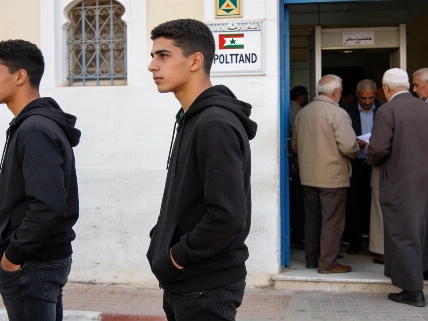
In Gabes, protests outside the governorate headquarters have become a regular occurrence. In Sidi Bouzid, the birthplace of Tunisia's revolution, the old slogan "Work, freedom, national dignity" is back. In Kasserine, entire families-including children-have joined the marches, a sign of how deeply economic hardship is affecting households across the country, as reported by Capitalis.
Social unrest meets political paralysis
President Kais Saied has responded by holding high-level meetings and telling his ministers to align next year's finance law with a five-year plan for regional balance and job creation. But for many Tunisians, these promises sound empty. The National Democratic Socialist Party has accused the authorities of stalling on employment, saying that "the struggle of the unemployed is part of the struggle against exploitation and injustice."
Political figures see the unrest as more than a social crisis. Wissem Sghayer of the Republican Party argues that social and political demands are now inseparable, warning that as the crisis deepens, sectoral protests will merge with broader political action. The Tunisian General Labour Union (UGTT), the country's largest trade union, confirmed at its 9-10 September 2026 meeting that it is considering a general strike and has tasked its executive bureau with preparing a phased action plan, though no date has been set. The UGTT leadership has linked the rise in protests to worsening political, economic, and social conditions, as well as the suspension of social dialogue, according to statements relayed by Business News and TAP.
Protesters demand action, not words
For those protesting, the issues are immediate and personal. Wiam Othmani, a civil society activist and one of the unemployed in Menzel Bouzaiane, describes a movement that is peaceful but determined to keep going until Law No. 18 is enforced. "Fourteen years have passed without her being employed, while some people have been unemployed for 20 or 25 years, or even longer," she says. The protests have no formal leadership; instead, participants organise themselves to keep things peaceful and focused on jobs and dignity.
Researcher Ramadhan Ben Omar notes that the protests are growing and spreading, putting the authorities under pressure: either implement the law and recruit long-term unemployed graduates, or risk the movement expanding as more groups join in. The government's usual tactics-repression and talk of conspiracies-are losing credibility among people who are tired of manipulation and broken promises. The Algerian Press Service (APS) has pointed out similar protest patterns and state responses in neighbouring countries, showing that Tunisia's crisis has regional echoes.
Social and political tracks converge
Former foreign minister Rafik Abdessalem sees the current mobilisation as similar to the period before the revolution, with the authorities' refusal to engage in dialogue or meet basic needs fuelling unrest. He notes that social and political movements, once separate, are now coming together, especially as protests adopt political slogans aimed at the head of state. The UGTT's recent statements have also tied trade union demands to broader issues of freedom and opposition to political trials, a position echoed in recent communiqués from the Ministry of Social Affairs.
Abdessalem argues that Tunisia is returning to its tradition of coordinated political and social action, facing an authority that, in his words, seeks to "undermine all intermediary bodies and destroy all the gains brought by the revolution." He believes that social demands alone have limited impact, but when combined with political action, they can drive real change.
What happens next
The authorities now face a clear choice: enforce Law No. 18 of 2025 and address the grievances of the long-term unemployed, or risk a broader convergence of social and political opposition. The UGTT's renewed activism, along with more residents joining protests, points to a shift in the balance of power. As the crisis deepens, the chance of a new phase of mobilisation-one that unites social and political forces-grows.
For outside observers, this wave of protests is not simply a repeat of past unrest. Tunisia's social and political fault lines are aligning in ways that could reshape the country's future. As previously reported earlier, Tunisia's internal dynamics are increasingly tied to its regional position, and the outcome of this confrontation will be felt beyond its borders. The government's credibility now depends on delivering real results, not just promises. If the authorities continue to rely on repression and delay, they risk triggering a new era of mobilisation that could change the balance of power in Tunisia and the wider Maghreb.