The Man-Made River Authority has restored water flow to Tripoli and surrounding areas after a nationwide power outage halted pumping operations, temporarily cutting off supply to millions and emptying basic pipelines.
The Man-Made River Authority (MMR) has announced the restoration of water flow through the Hasawna-Jafara Plain system following a nationwide power outage that forced a complete shutdown of pumping stations and left pipelines empty. The disruption halted water supply to Tripoli and several other areas, affecting an estimated three million people.
Information from the MMR, water has reached the Garabulli Reservoir and is moving towards the Sayeh Reservoir, which supplies the capital. The authority expects water to arrive in Tripoli by the evening, with supply levels recovering progressively as the network returns to operation.
Power Outage Disrupts Strategic Water Infrastructure
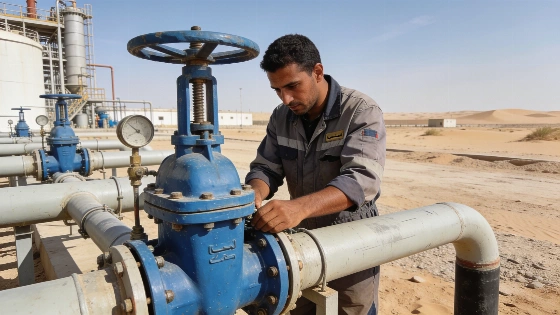
The outage began with the shutdown of the Hasawna well fields, followed by the Tarhuna and Rabta pumping stations. This sequence led to a rapid fall in water levels and emptied the eastern pipeline, which runs from Shuwayrif through Tarhuna and Garabulli, then via Khoms to Tripoli. The incident illustrates how grid failures can interrupt delivery even when groundwater remains available: the system relies on electrically powered wells and pumps to move water through long-distance pipelines and reservoirs.
Construction of the Great Man-Made River began in 1983. Its wells draw fossil groundwater from the Nubian Sandstone Aquifer System, with major supply fields at Sarir and Tazerbo, as well as Kufra and Jabal al-Hasawna. The network transfers water from inland basins to northern population centres, including Tripoli and Benghazi, with Sirte also on the system. Its pumping and control infrastructure is basic to urban water security.
The current disruption also comes against a background of longstanding operational pressures. In 2019, about 1.5 million people, including roughly 600,000 children, were reported to rely on the system as their basic freshwater source. At that time, 96 of 366 wells were recorded as out of service; subsequent reporting cited 101 dismantled wells among 479 on the western system. Abdullah El-Sunni, then head of the Tripoli water authority, said western-system flow had fallen from a normal 1.2 million cubic metres a day to about 800,000.
Earlier interruptions have also exposed the network’s vulnerability to damage beyond electricity outages. On 19 May 2019, a shutdown at the Jabal al-Hasawna control station deprived civilians of water. Maria Ribeiro, then the United Nations Humanitarian Coordinator for Libya, said it had left “hundreds of thousands of already embattled Libyans” without safe drinking water. Damage to wells and infrastructure has added to the challenge of maintaining reliable service.
Implications for Urban Supply and Infrastructure Ability to recover
The progress of water from Garabulli towards Sayeh is consistent with a staged restart: well fields and pumping stations must resume operating first, followed by pipelines and reservoirs. After pumping stops, pressure and water levels can fall along a pipeline route, so restoring electricity does not necessarily restore household supply immediately.
Libya’s electricity-sector problems so remain closely tied to water reliability. An emergency plan discussed by the Ministry of Planning and the General Electricity Company of Libya identified power-generation readiness as a priority, alongside maintenance and overhauls. It also cited transmission and distribution problems, as well as shortages of spare parts. The plan aims to improve the reliability and stability of electricity supplies, on which the Man-Made River’s wells and pumping stations depend.
While the MMR has restored flow, the incident underscores the system’s strategic importance to Tripoli and other urban areas, as well as the need to maintain infrastructure that moves water across the country. The authority has not indicated when full operational stability will be achieved; supply is expected to recover as water levels normalize across the network. The river’s dependence on a functioning power grid and finite fossil groundwater also makes maintenance and leakage control, alongside long-term resource management, impressive to Libya’s water security.